2026 Gallery
Contents of this page:-
Pastures New, Waters of Old (Isle of Arran, April 2026)
Our Quest to Find a Home on Scotland’s Isle of Arran!
Red Barn Bluebells (Dartmoor, May 2026)
Twin Trips in Search of Spring Colour on the High Moor
The Ancient Oak of Uffculme (Devon Countryside, June 2026)
A Final Devon Shoot unearths a Thousand-year-old New Friend!
Caledonian Dawn (Lamlash Bay, August 2026)
The Dawning of an Exciting New Era on the Beautiful Isle of Arran!
From Funnels to Tunnels (East of Arran, September 2026)
All Roads Lead to Lamlash… where Tunnel Vision prevails!
Heron Highwater (Lamlash Bay, October 2026)
My Predilection for ‘Dynamic Seascapes’ is Photo-Bombed by our Local Wader!
Black & White and Watery Light (‘Clauchs & Glens’, October 2026)
Ongoing Aqueous Antics at Clauchlands Point, Glenashdale and Glen Rosa
Russet and Rosa (Glenrosa Water & Wood, October 2026)
A Return to Glen Rosa seeks Autumn Colour… yet finds a Submerged Alien!
Pastures New, Waters of Old
(Isle of Arran, April 2026)
For me, the start of 2026 heralded a time of great personal change. More specifically, early retirement (at the end of March) ushered in the exciting (albeit nerve-wracking) prospect of a family relocation from Devon to the beautiful Isle of Arran! :-0
Yet if (as I hope) retirement allows considerably more time for photographic therapy, then its frantic run-up has sadly offered the reverse. My last few months handing over a seeming epoch’s worth of office work, combined with expanding house-move preparations, conspired to soak up any free time which might otherwise have been spent with camera in hand. So in the end, it was only during our actual house-hunting trip to Arran (during April) that I was able to steal a few precious moments in which to break the five-month photographic detox which I’d endured since Cornwall last November.*
*Yes, I do know how lucky I am to be retiring early and moving to Arran - please take any protestations of hardship with a wry grain of salt! ;-)
Glenashdale Falls
When the time came - with some intriguing Arran house viewings already in the bag - my photographic return would take the form of an old, unfinished quest: to somehow view (and photograph) Whiting Bay’s celebrated Glenashdale Falls from directly below. Ironically, I would end up doing the exact opposite!
I’ve previously written about the challenge of accessing the steeply forested Glenashdale gorge, into which the river plunges 150 feet through a pair of spectacular white-water cascades. I’d already attempted scrambling down both the north bank and the south bank, as well as sploshing upstream in a natty pair of fishing waders. This time, I slid and scraped my way down to the section of river immediately above The Cauldron, a deep bubbling recess which had thwarted my progress last May. But alas, the onward terrain remained ominously hazardous. I retreated: at Glenashdale, discretion is usually the better part of valour!
After scrambling back up to re-join our friend Melissa, I settled for a shot looking down across the upper fall from a precarious perch on its lip (one tripod leg being right on the edge!). Mel managed to video me on her mobile phone as I set things up, lost in a wee world of my own as I faffed with the inevitable filters… :-)
”Naughty Paul” by Mel Grenfell
(Play with sound enabled for a real impression of the place!)
Predictably, the resulting composition - my first in five months - was hardly the original masterpiece that I’d aspired to. Nonetheless, it hopefully provides a counterpoint to the well-worn (admittedly iconic) image of Glenashdale Falls from the ready-made viewing platform opposite.
If my image does work at all (I’m not the best judge of that!), then I think it’s on account of the brittle twigs which seem to sprout from the top of the falls, as though clinging on for dear life. At the very least, this humble sprig ensures that the inspiration for the picture’s title - On the Brink - needn’t be the exclusive preserve of the reckless photographer! :-0
Above all, it was lovely to renew my favourite mini-project of 2025… a pictorial tribute to The Waters of Arran.
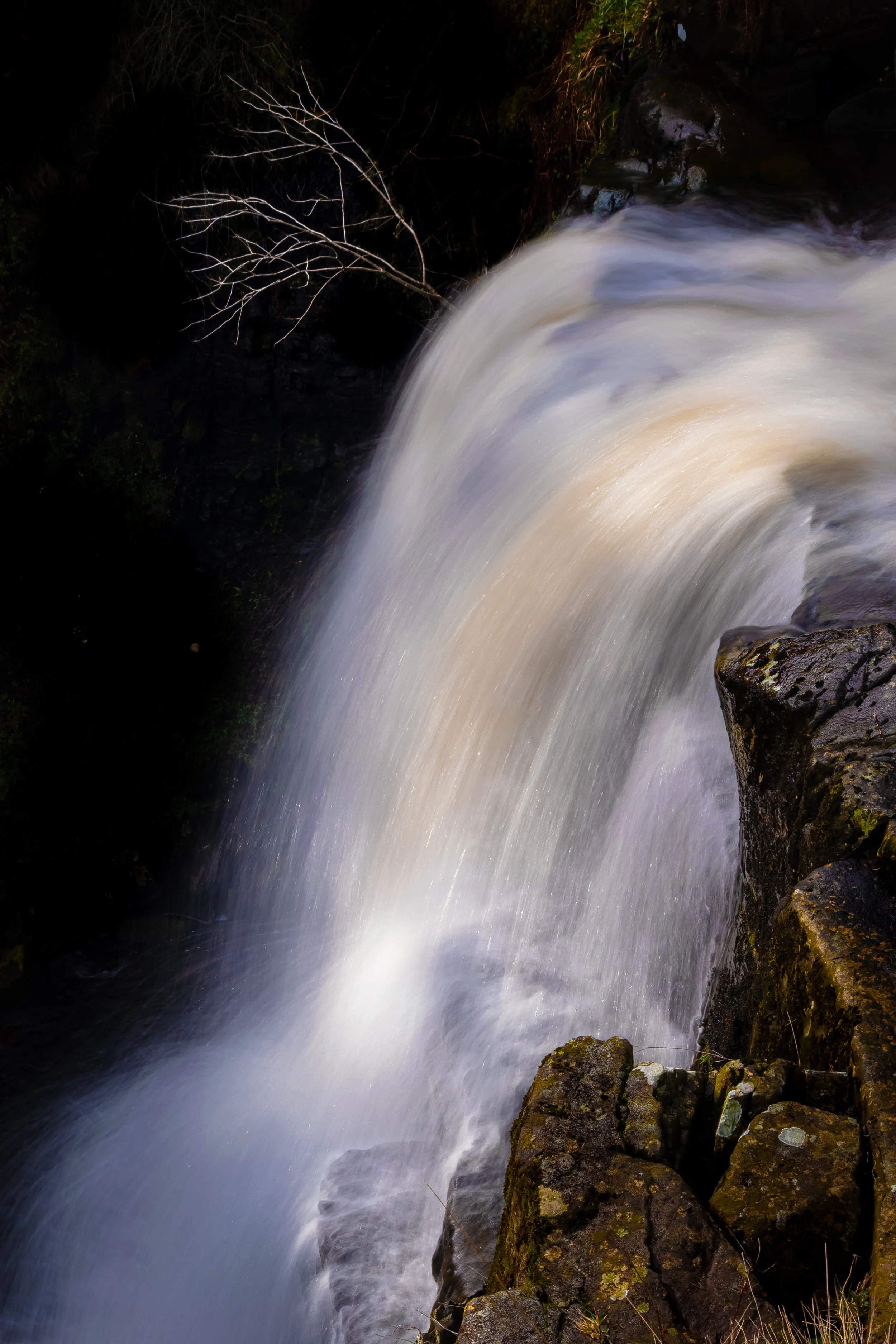
On the Brink…
A lone sprig of twigs teeters on the edge of Glenashdale Falls
Glenashdale - Shooting the Shoot
It’s unusual for me to be accompanied on a photoshoot, let alone to view the action through somebody else’s lens. So I’m grateful to Mel for sharing some of her insightful mobile phone shots, which neatly supplement the above waterfall video.
Given that my own contribution to this walk was just a single image, the extra context provided by these pics is much appreciated. And actually, Mel’s documentary style has given me an idea: perhaps we should join forces and start a photographic YouTube channel, moving the underlying story front and centre. It’s certainly a tried and trusted formula… though maybe I’ll consolidate this website first, and see how things go! ;-)
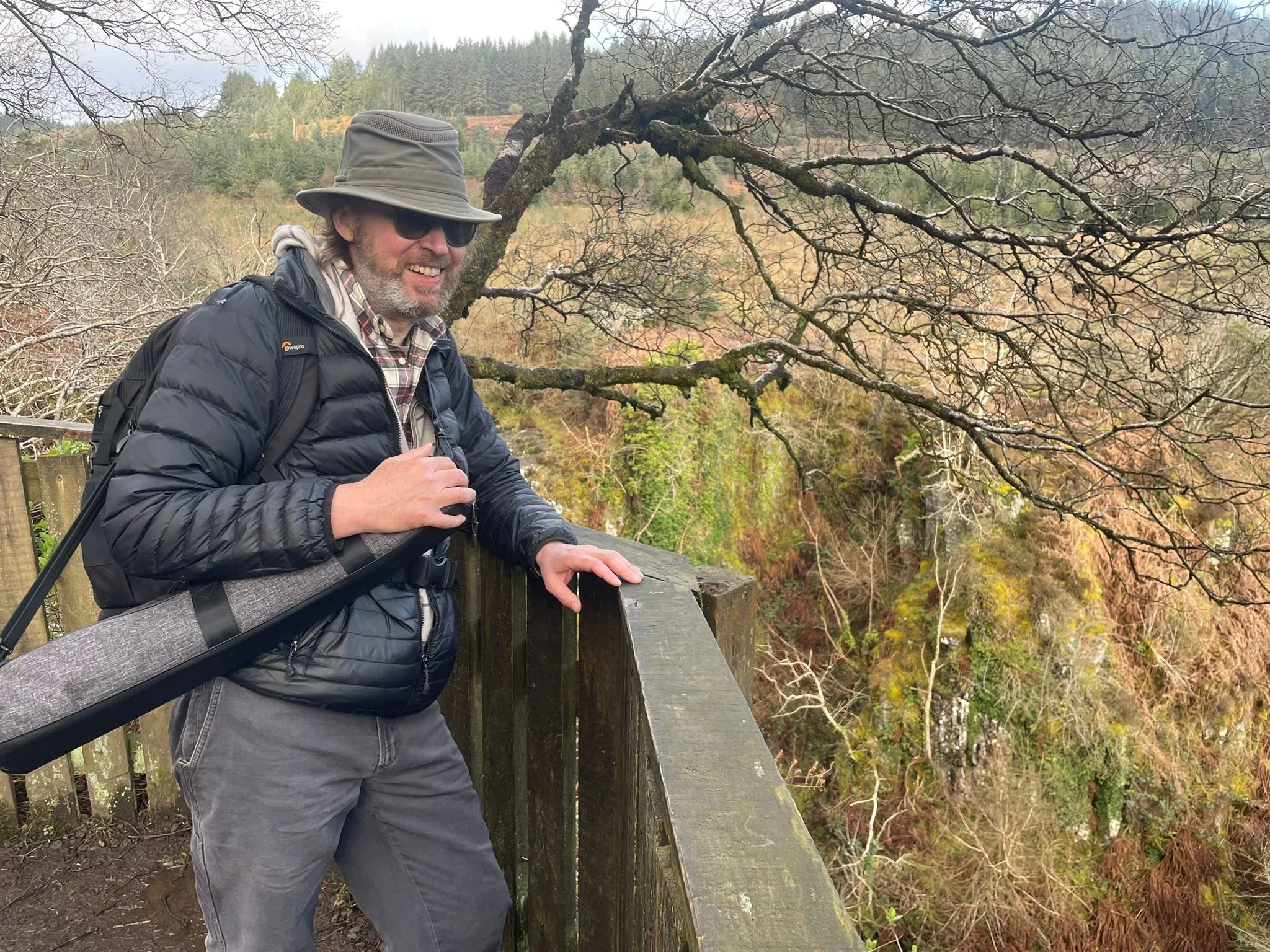
To shoot or not to shoot? Paul on the fence at Glenashdale…
(Photo by Mel Grenfell)
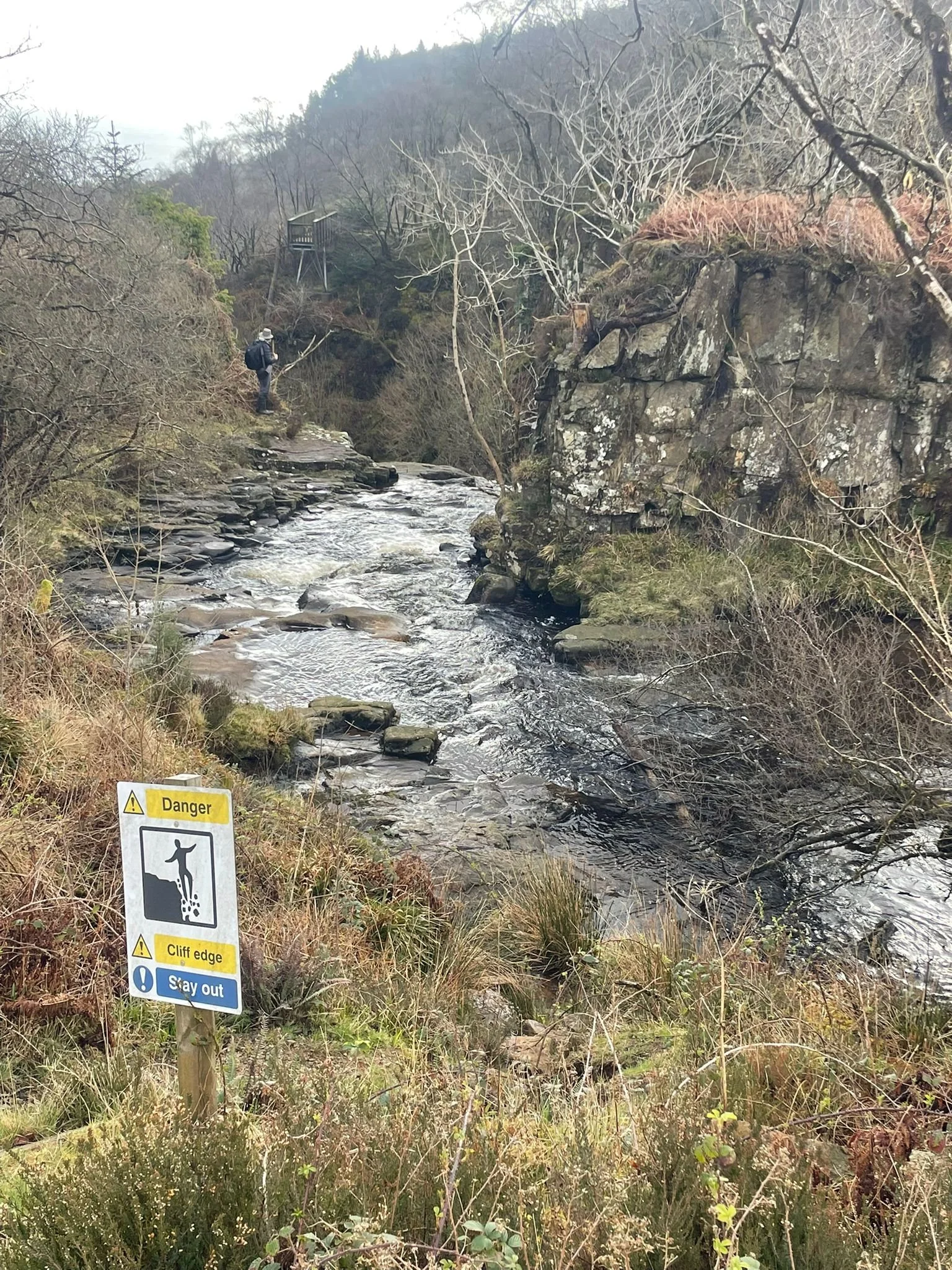
Missing those danger signs…
(Photo by Mel Grenfell)
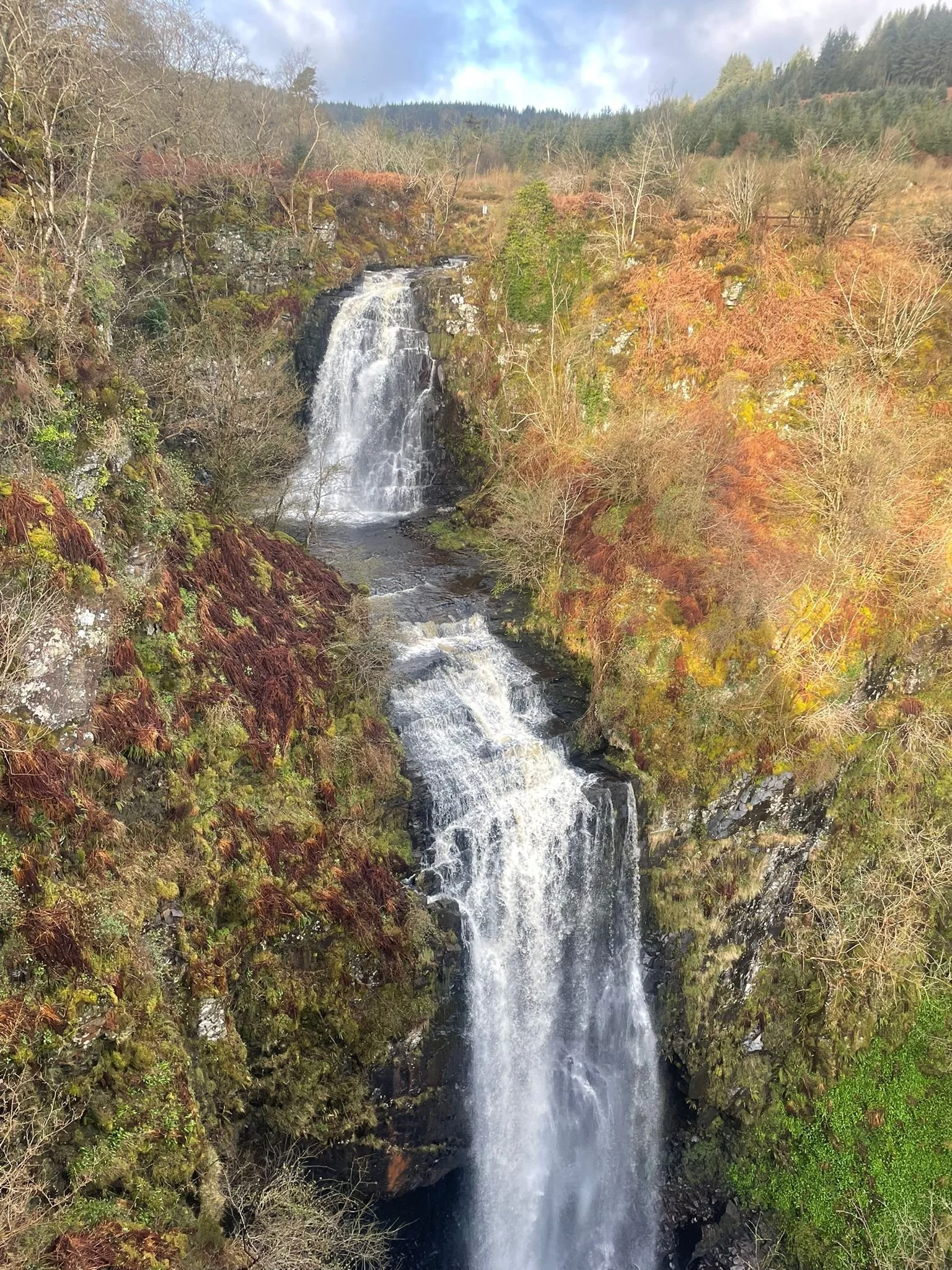
Glenashdale Falls, from the viewing platform
(Photo by Mel Grenfell)
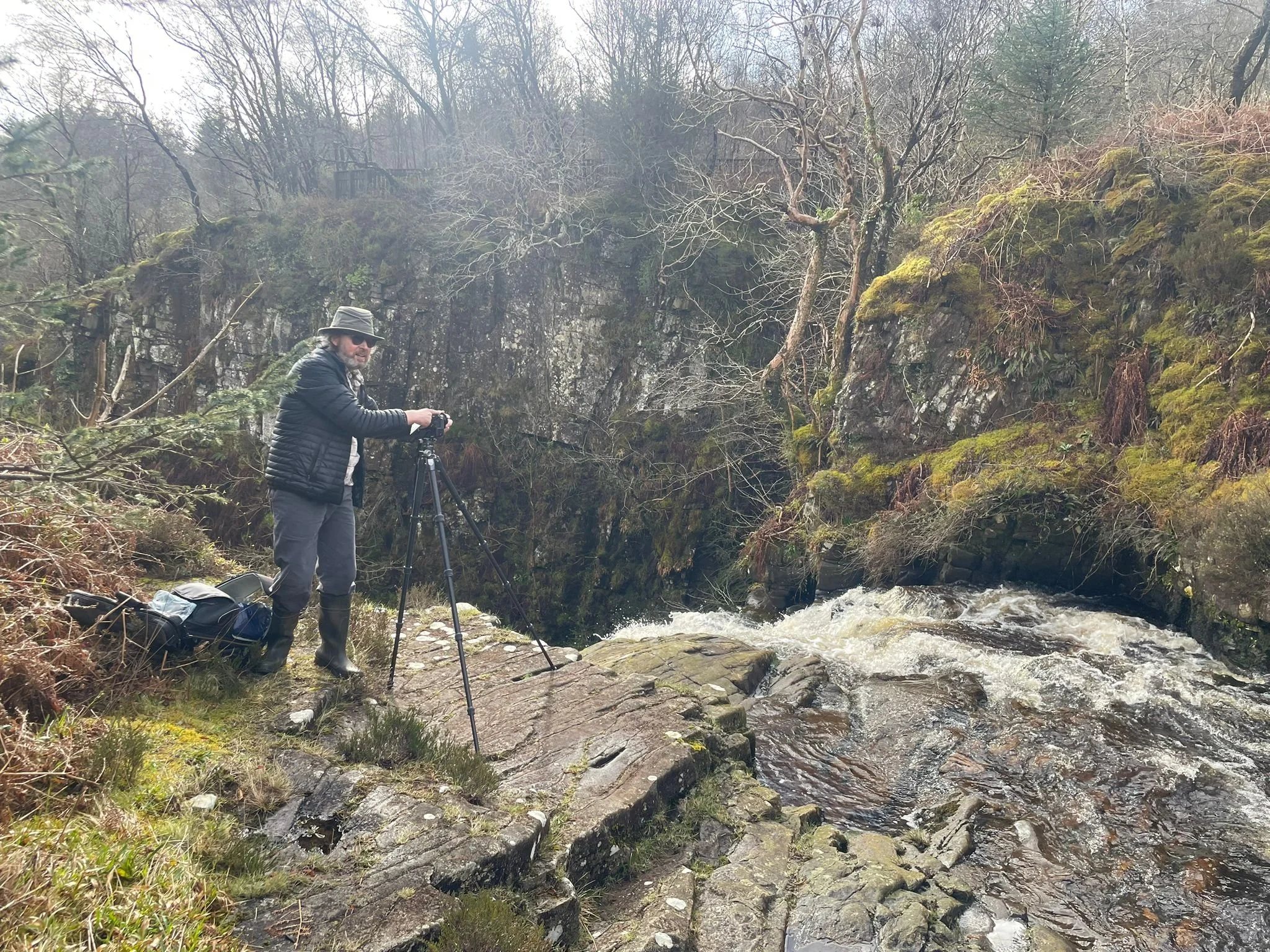
Composing myself… top of the falls
(Photo by Mel Grenfell)
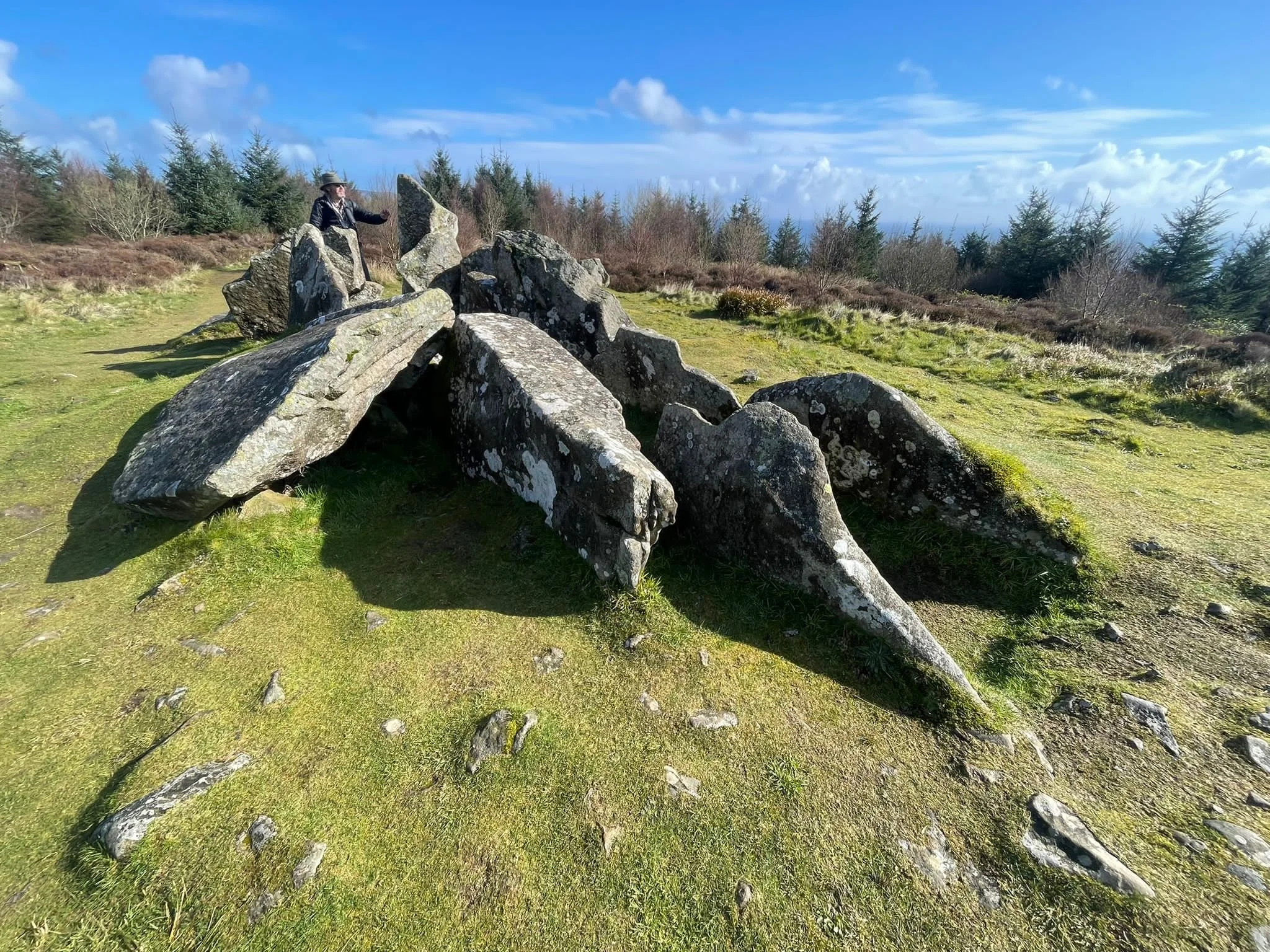
Glenashdale to Whiting Bay… via the neolithic Giants’ Graves
(Photo by Mel Grenfell)
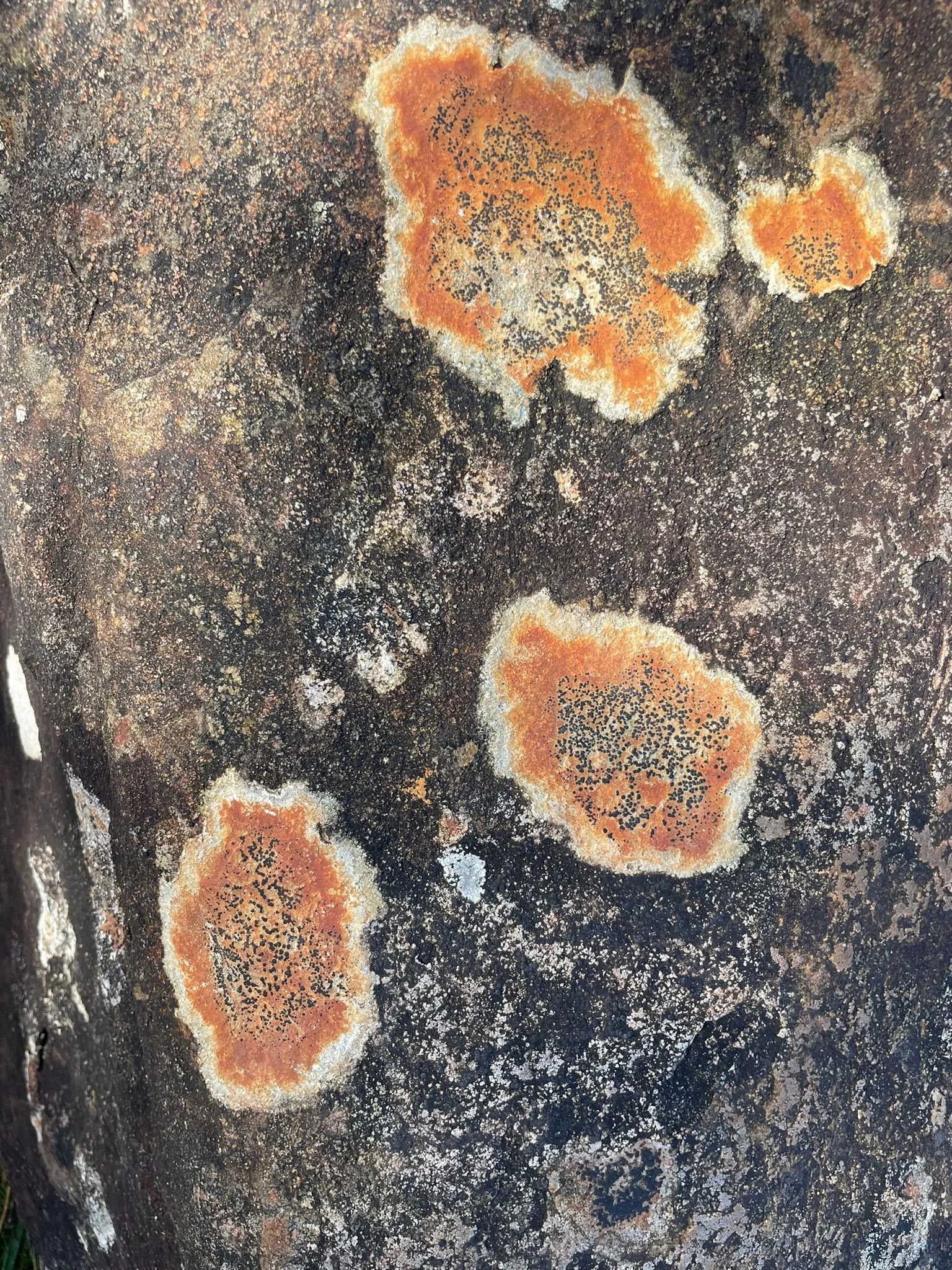
If you like Mel’s images… “Lichen subscribe!“
(Photo by Mel Grenfell)
The Fairy Glen
Glenashdale may be the ‘big hitter’ when it comes to Whiting Bay’s countryside walks (and forested falls)… however, it’s far from being the only attraction in town.
Although the Fairy Glen is smaller in scale, in some ways this makes it even more photogenic. And in practical terms, its discrete location - tucked away just up the hill behind our holiday cottage at Smiddy Brae - made it ideal for whiling away a grey, rainy morning.
Ah, a rainy day and a burn in spate… what better excuse could there be for breaking out my ever-fashionable fishing waders (while carefully avoiding being photographed in them)?! :-0
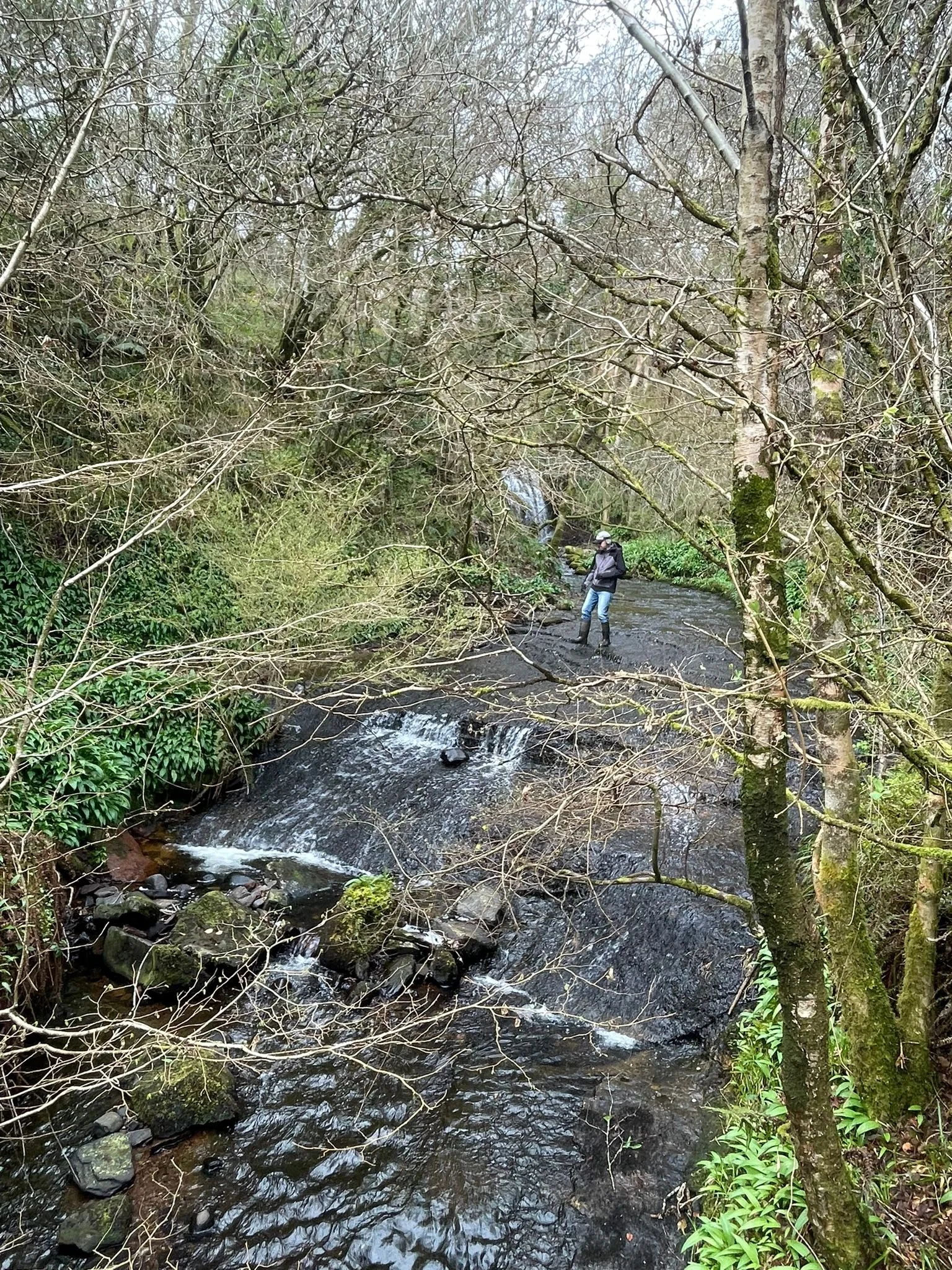
Not yet out of the woods… Paul scouts the Fairy Glen
(A pre-shoot dog-walk; photo by Mel Grenfell)
Now at this point, let me dispel a myth about weather and landscape photography. Blue skies and bright sunshine may be great for tourist brochures… but for anything more artistic, harsh light is rarely the photographer’s friend.
Yes, my On the Brink Glenashdale shot does benefit from direct sunlight on the waterfall (and twigs), offering contrast with the darkness beyond. But when in the depths of woodland, confronted with churning white water and bright green foliage, a softer, diffuse light will often lead to more satisfying results.
Also, as I’m generally fond of saying (usually to the annoyance of my long-suffering holiday companions)… the rain is great for topping up those thirsty burns and waterfalls! ;-)
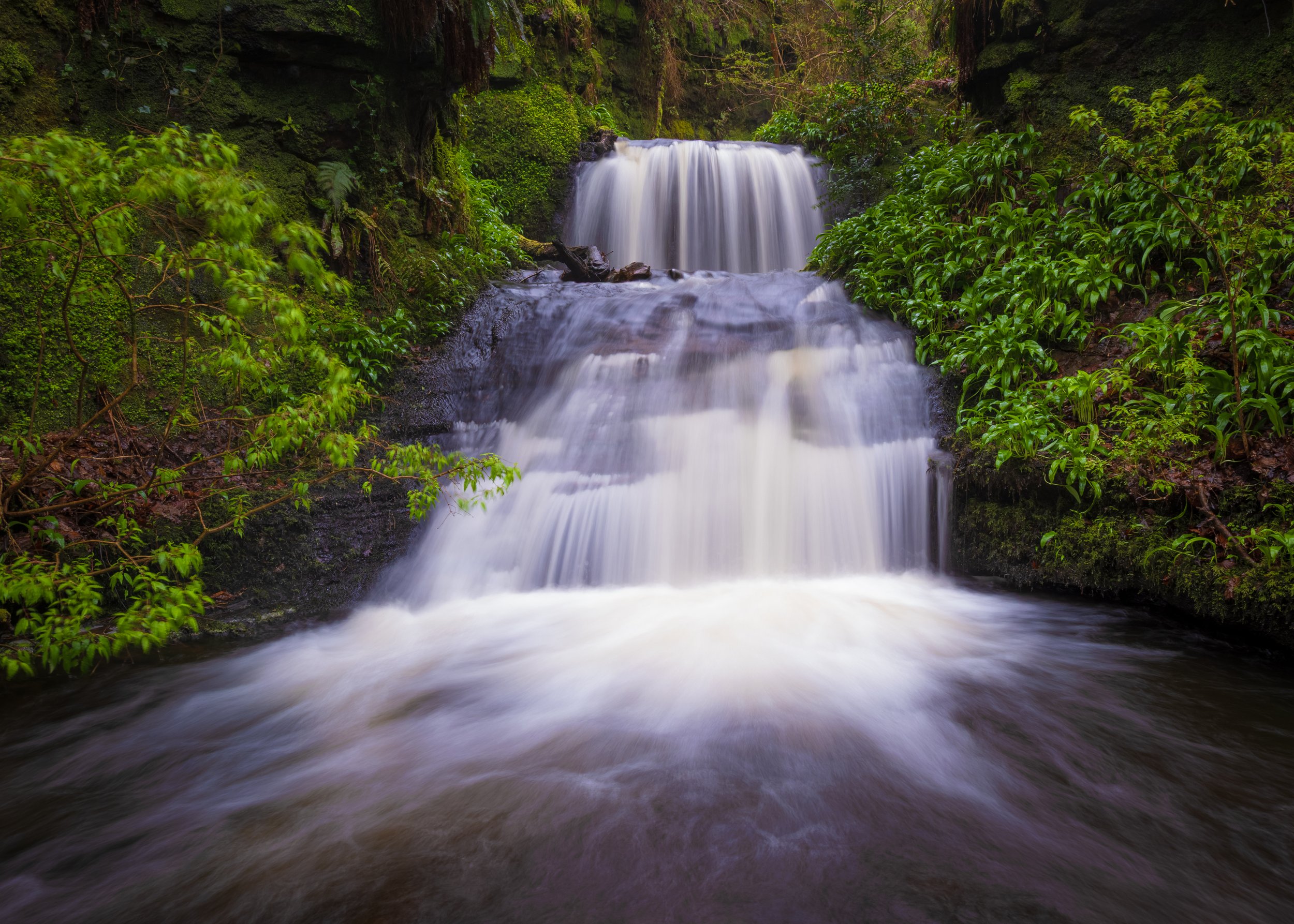
On this particular rainy morning, my soggy explorations of the Fairy Glen led to two distinct compositions (notwithstanding a little experimentation between landscape and portrait views).
The first of these compositions involved scrambling down a side-burn into a rocky gorge, from where I shakily anchored my tripod in the torrent. Just upstream were two tiered waterfalls, which comprised my main subject… while immediately below, the roar of two further falls ensured ongoing vigilance against slips, or ‘falls’ of the more unfortunate kind! :-0
My final composition - the one that I’m presenting below in both vertical and horizontal form - was a little safer of access, although it did still entail some delicate wading up the slippery Smiddy Brae Burn (a.k.a. Allt Ceirde). Mossy tree branches made a nice natural frame for the falls, offset by the fine fragrance of wild garlic… though I couldn’t help thinking that I should return later in the spring, when the latter is in bloom!
On a quick technical note, a further advantage of the overcast conditions was that I could shoot exposure times of around 1 second (to smooth the water) without needing to apply any filters. This meant that I could leave my lens hood attached, which helped keep raindrops off the glass. If only I’d applied such care to keeping everything else dry (myself included)!
Anyway, when shooting such special scenes, technical camera settings are hardly the point. The Fairy Glen is surely more about magic than mechanics… the real trick is just to get out there, soak it all in and enjoy it (come rain or shine)! ;-)
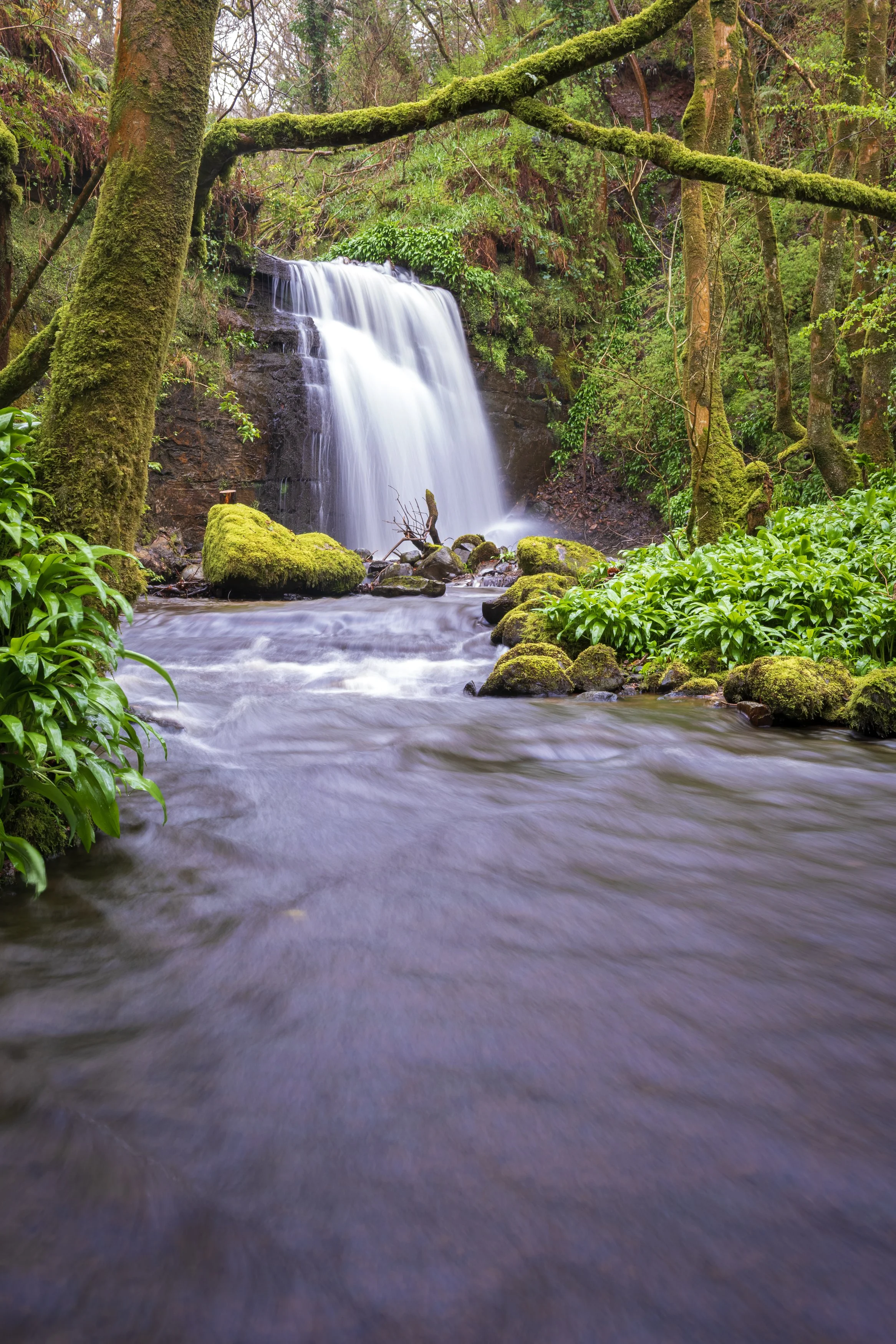
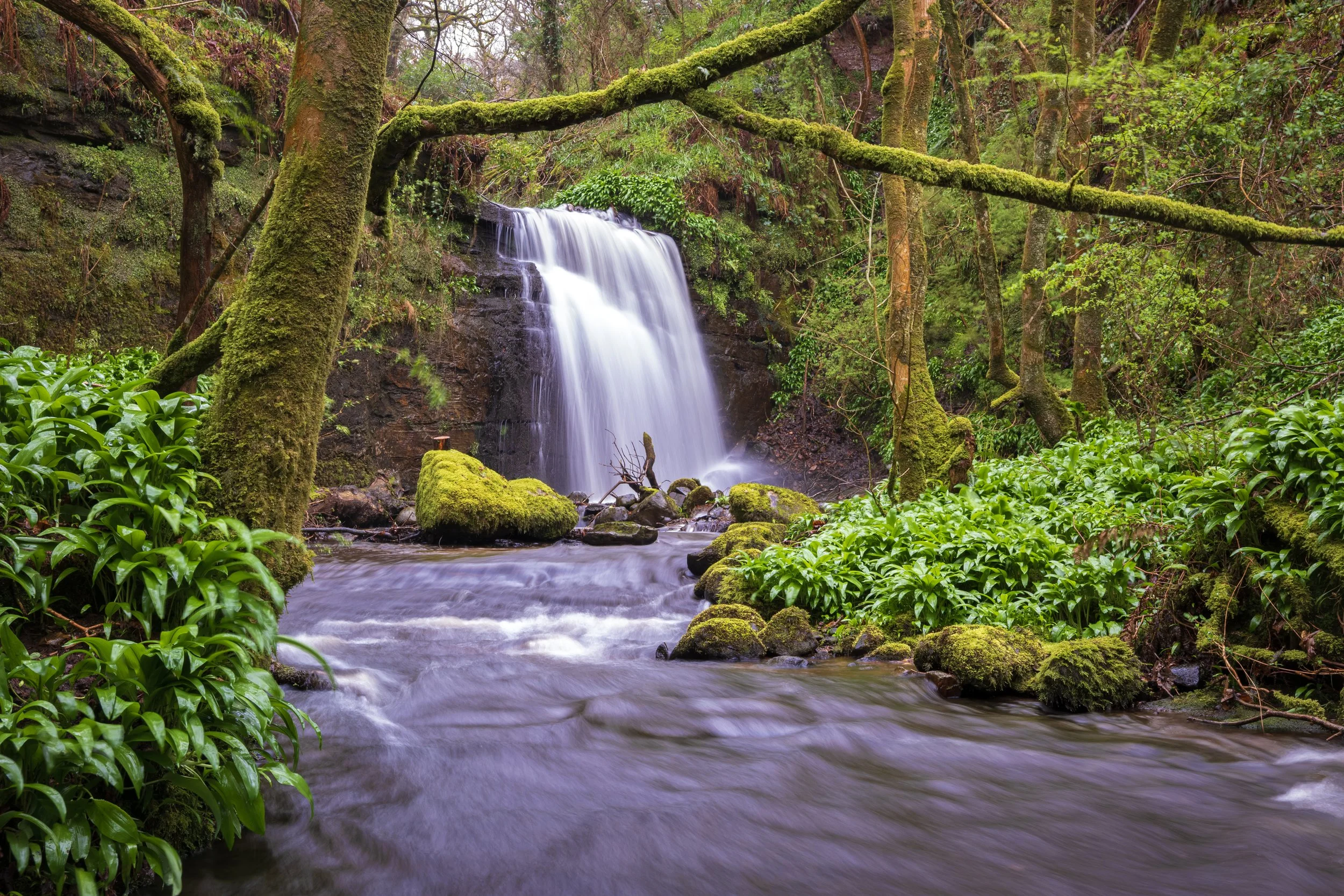
The Fairy Glade (in Portrait and Landscape)…
An energised Smiddy Brae Burn wends its way through the Fairy Glen
Round the Houses -
Views between the Viewings
Given the small matter of searching for a permanent home on the island, this was understandably the least holiday-like of our Arran holidays to date. And this is clearly reflected in our photographic record: between Karen and I, just a handful of images were created across the entire trip (and none at all using Karen’s wee Canon, which usually fills that ‘family holiday’ gap between my photoshoots and any quick moby offerings).
Now this is all fine, of course - and perhaps even a breakthrough, since we’re now seeing Arran as home rather than somewhere that needs to be assiduously documented. Nonetheless, this was still a holiday (house viewings aside), and beauty continued to surround us. So it was great that our erstwhile guest Mel - who has a wonderful eye for quirky, spontaneous mobile phone photography - was able to share some of her own images. They are presented here unedited (raw & untamed!)…
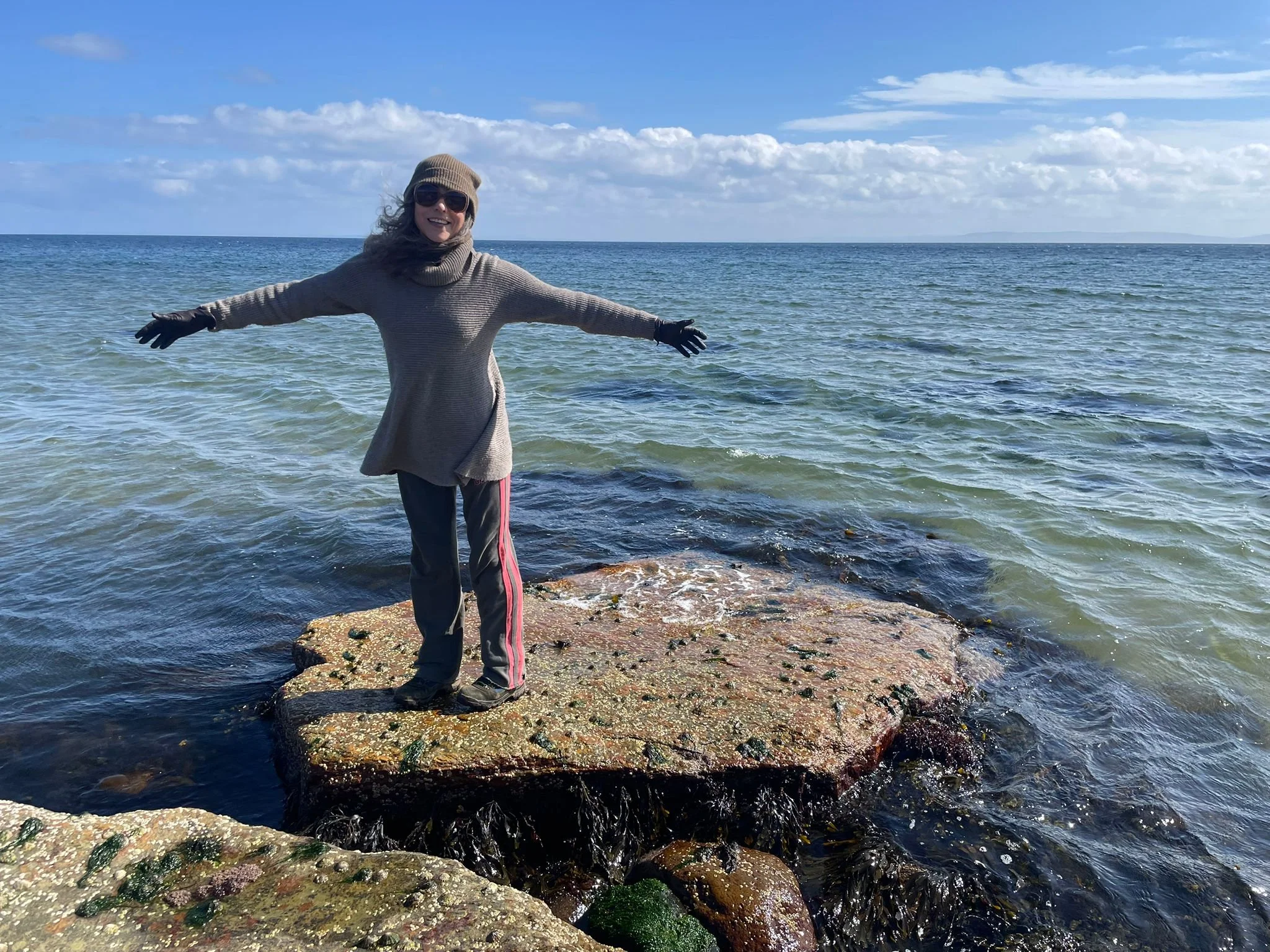
Mel, our friend and chronicler, reaches the end of Whiting Bay jetty
(Snapped by Paul, using Mel’s mobile phone)
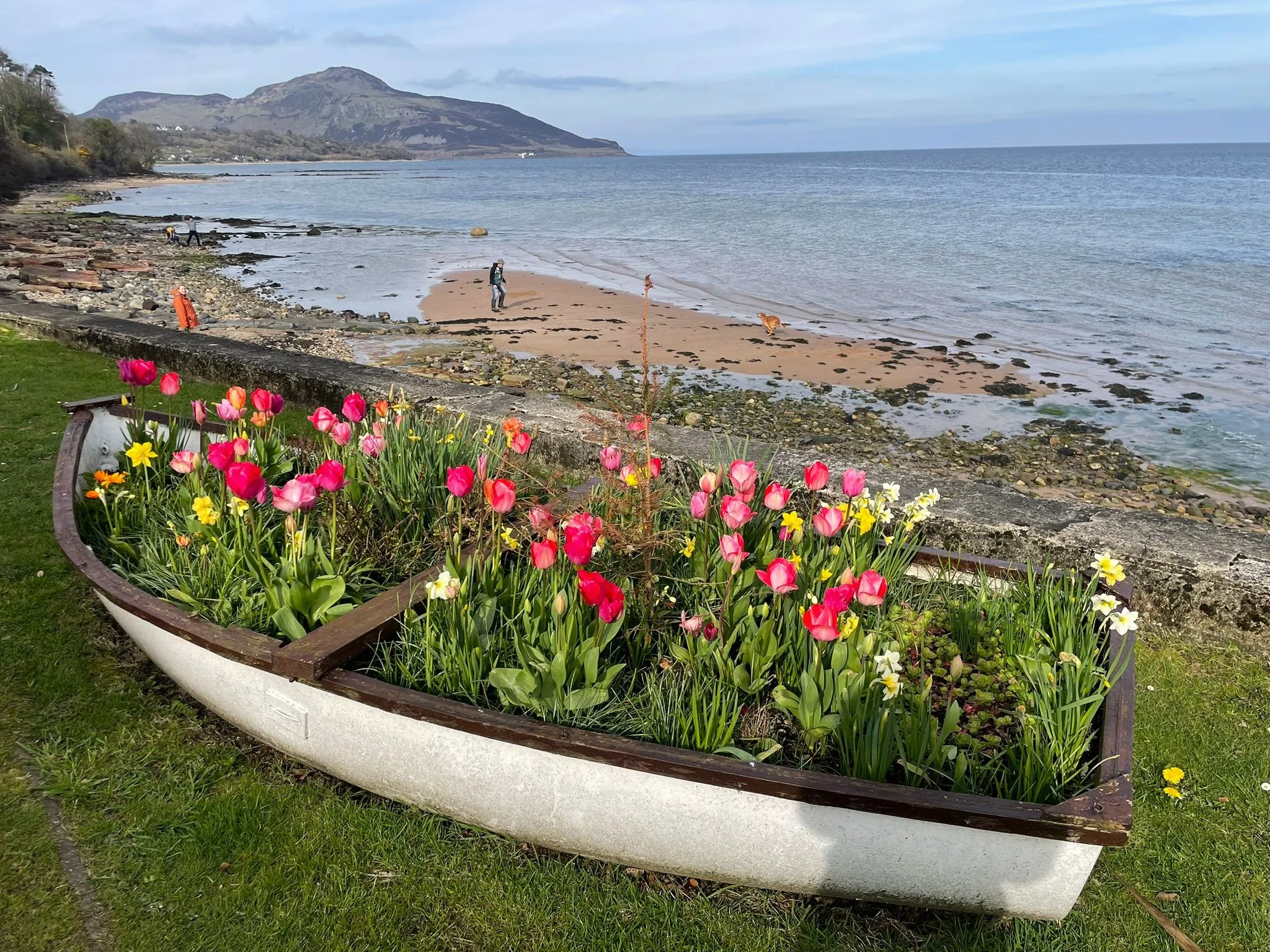
Larking on the beach - Karen in orange, Paul & Rocky on the sandbar
(Whiting Bay shore; photo by Mel Grenfell)
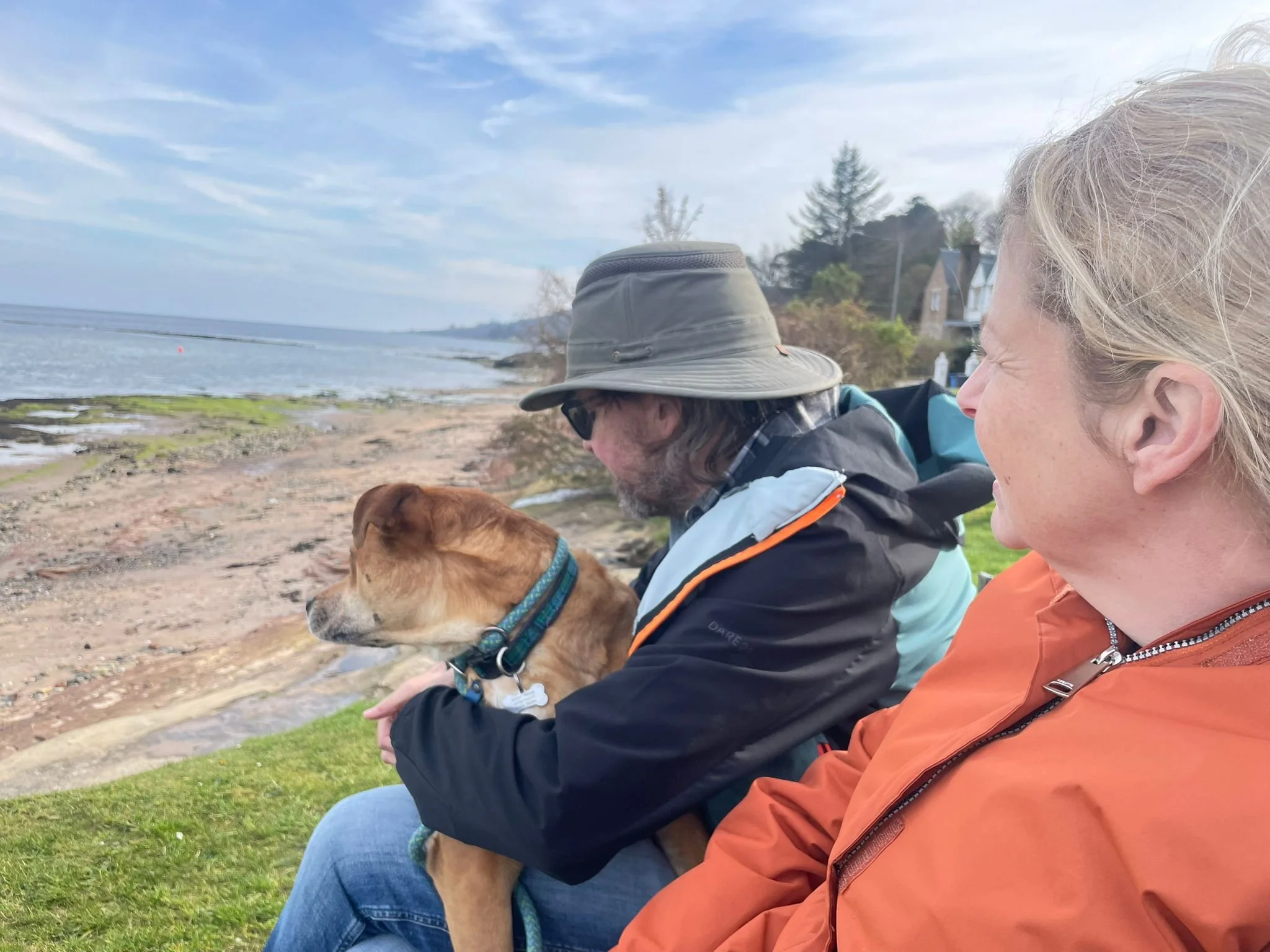
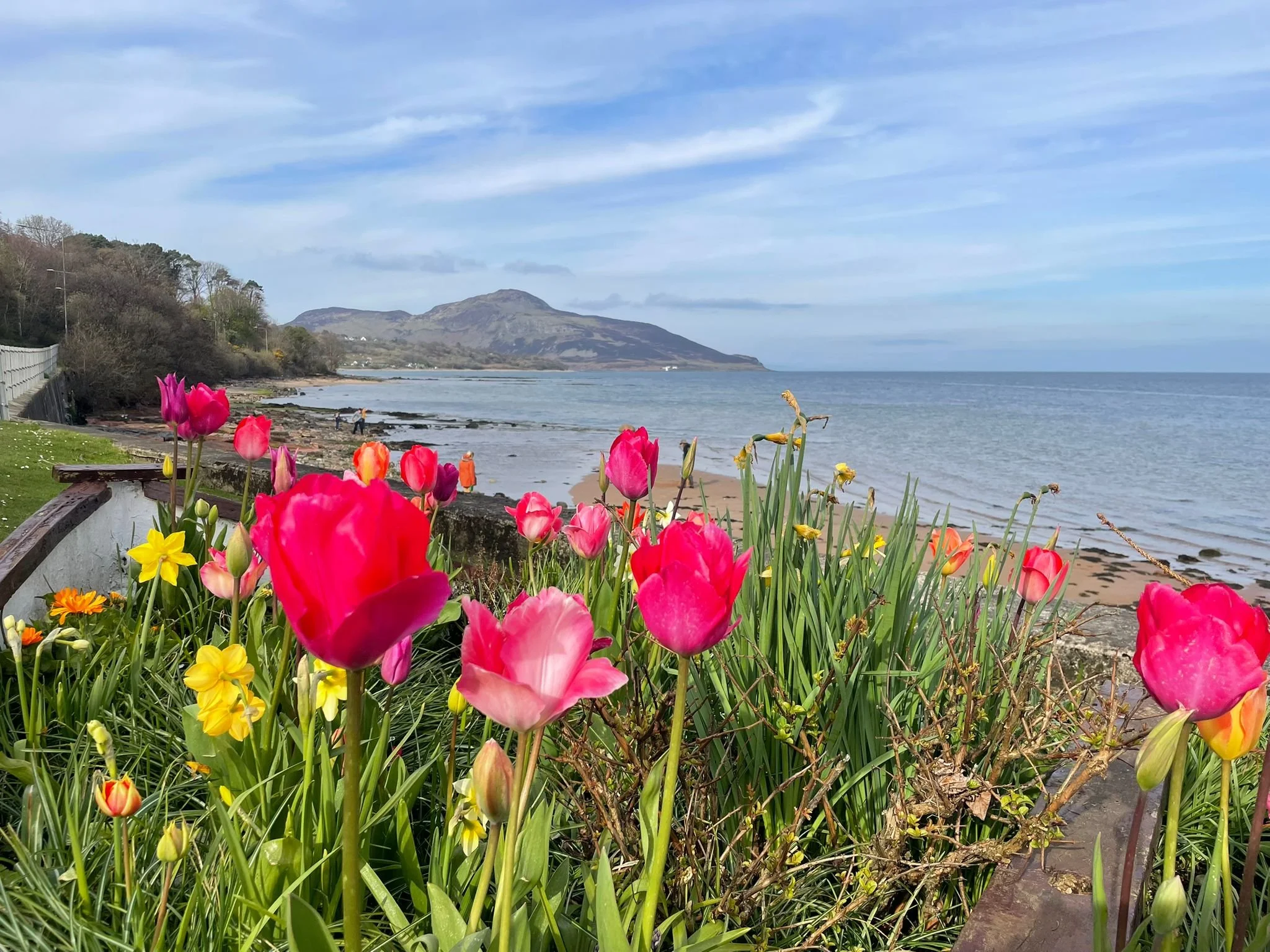
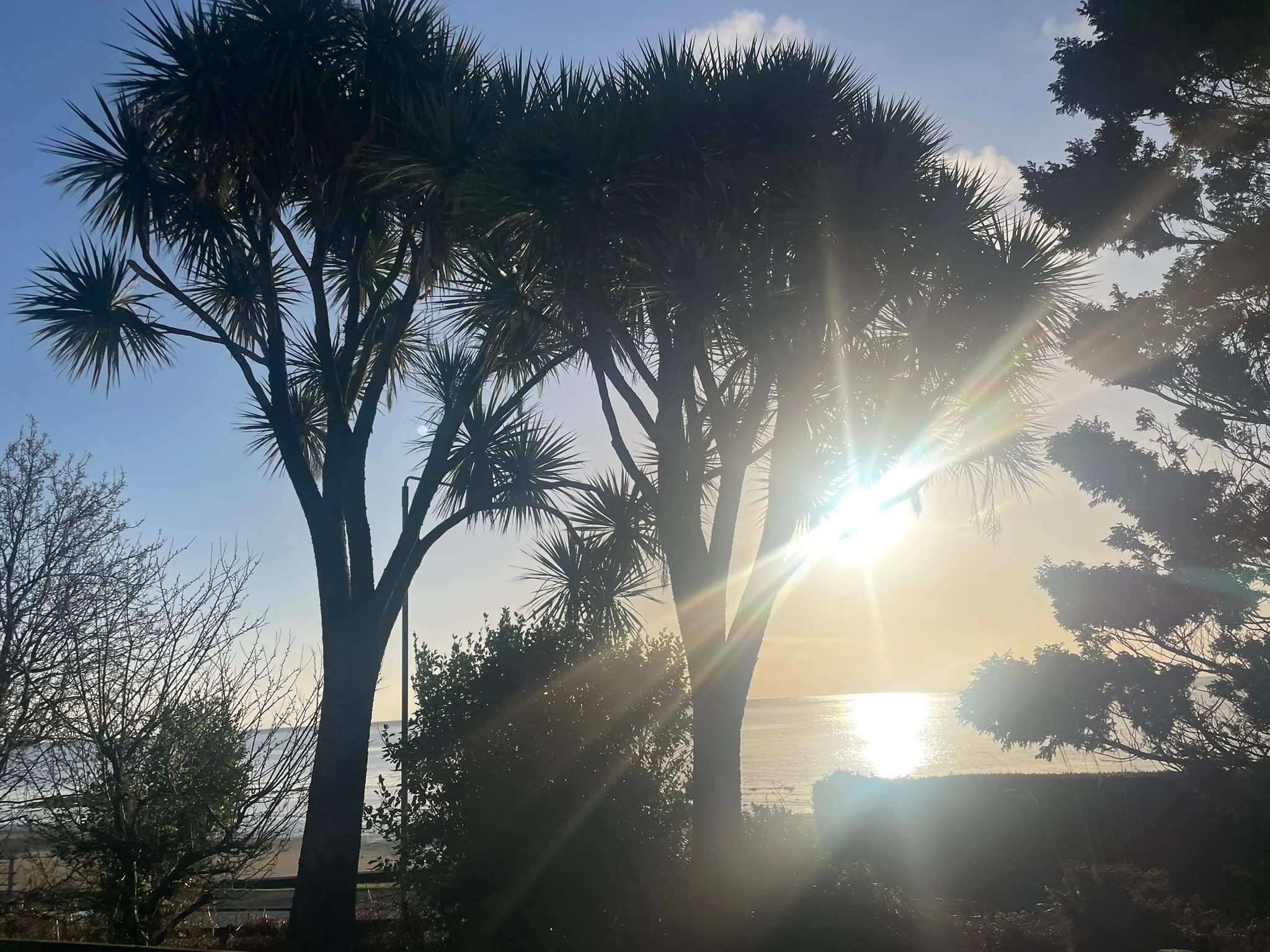
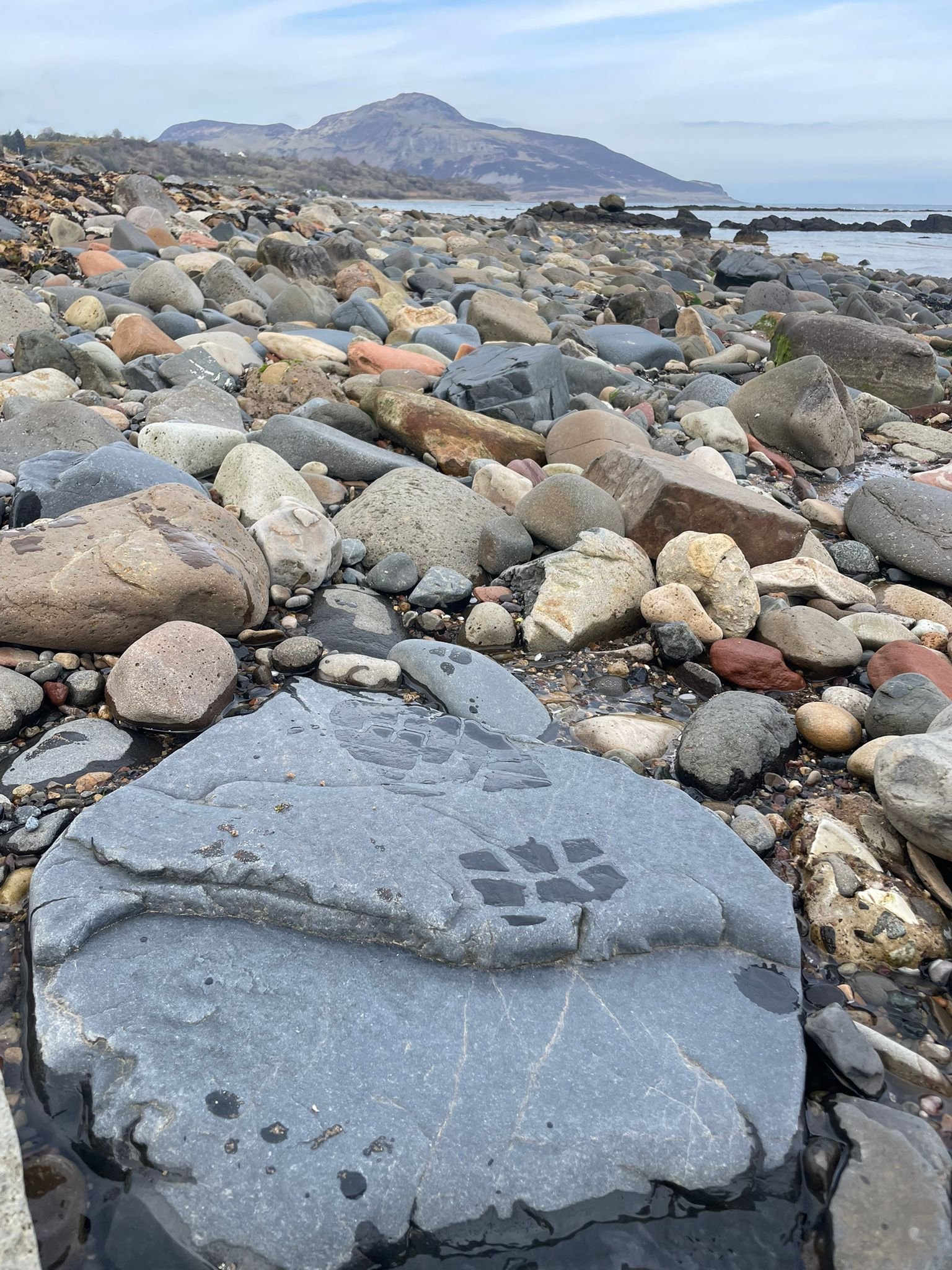
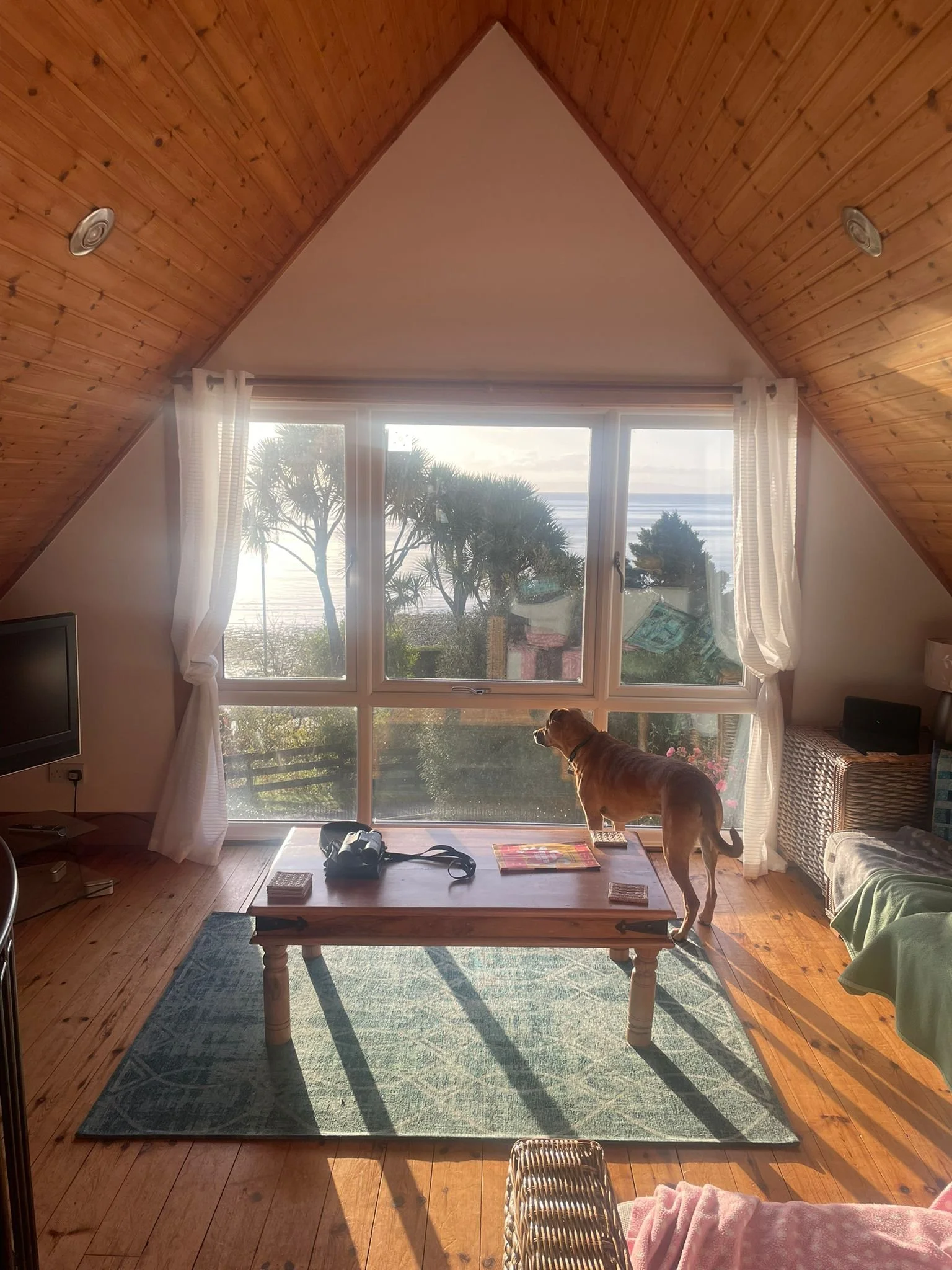
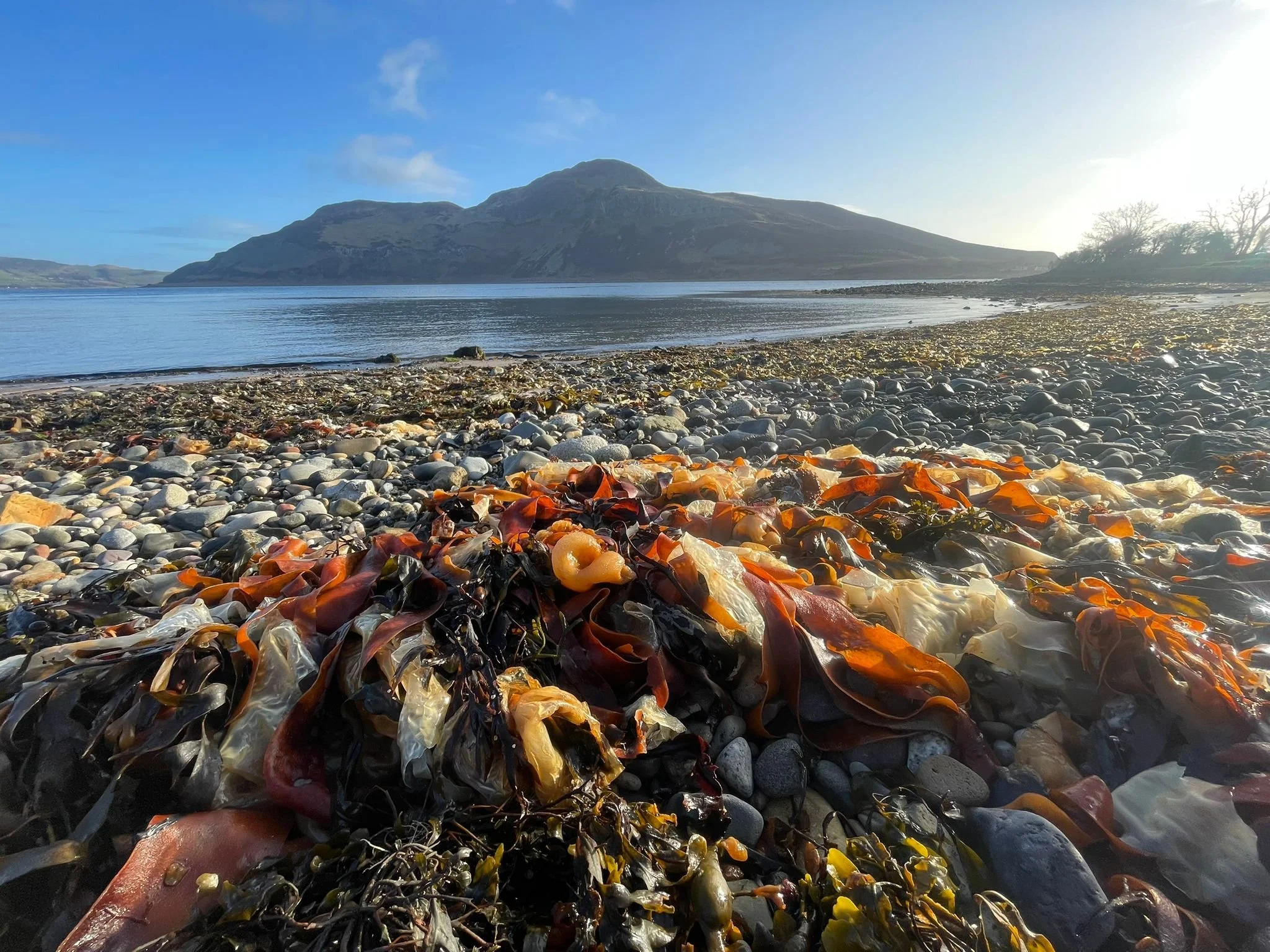
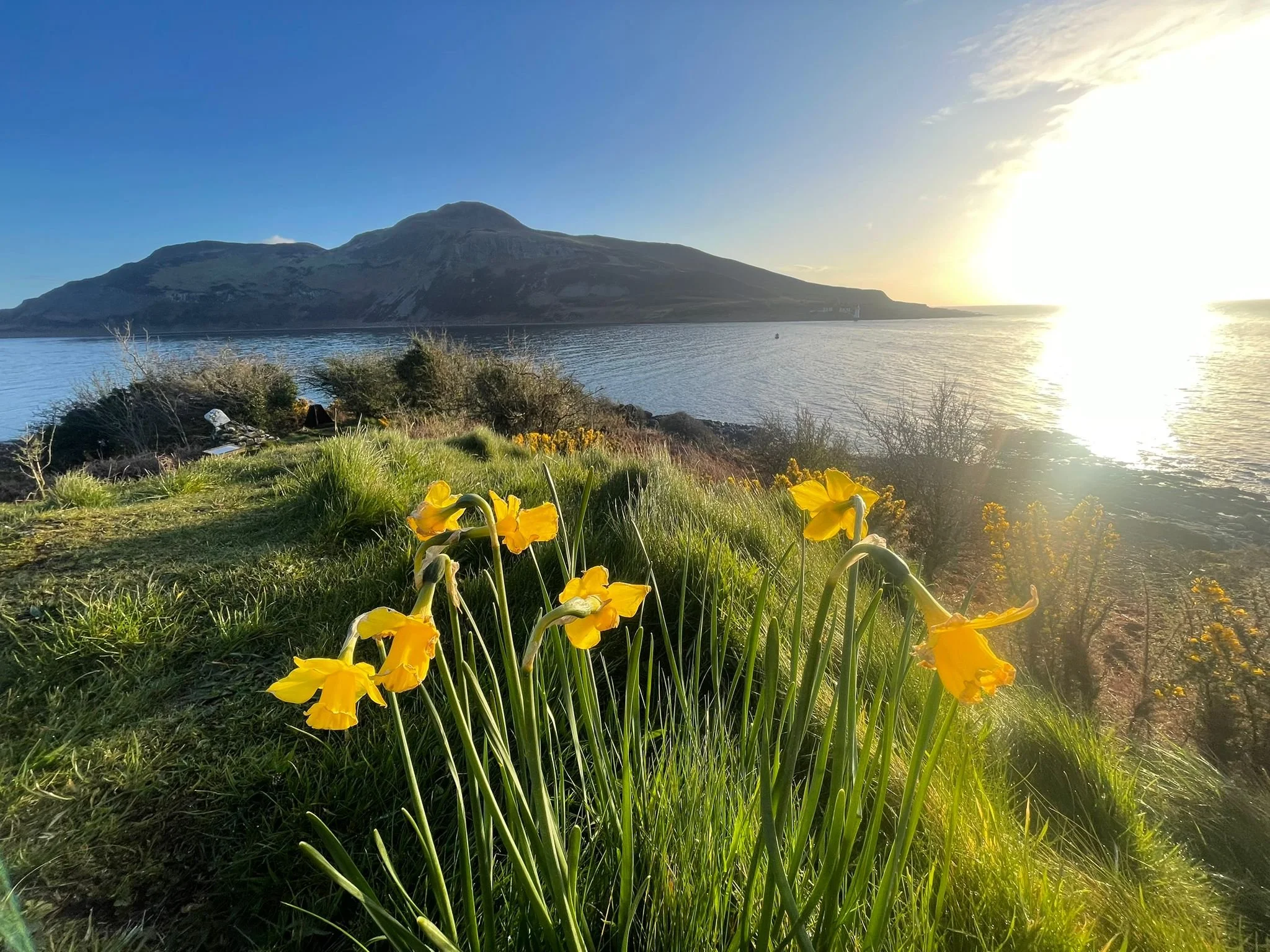
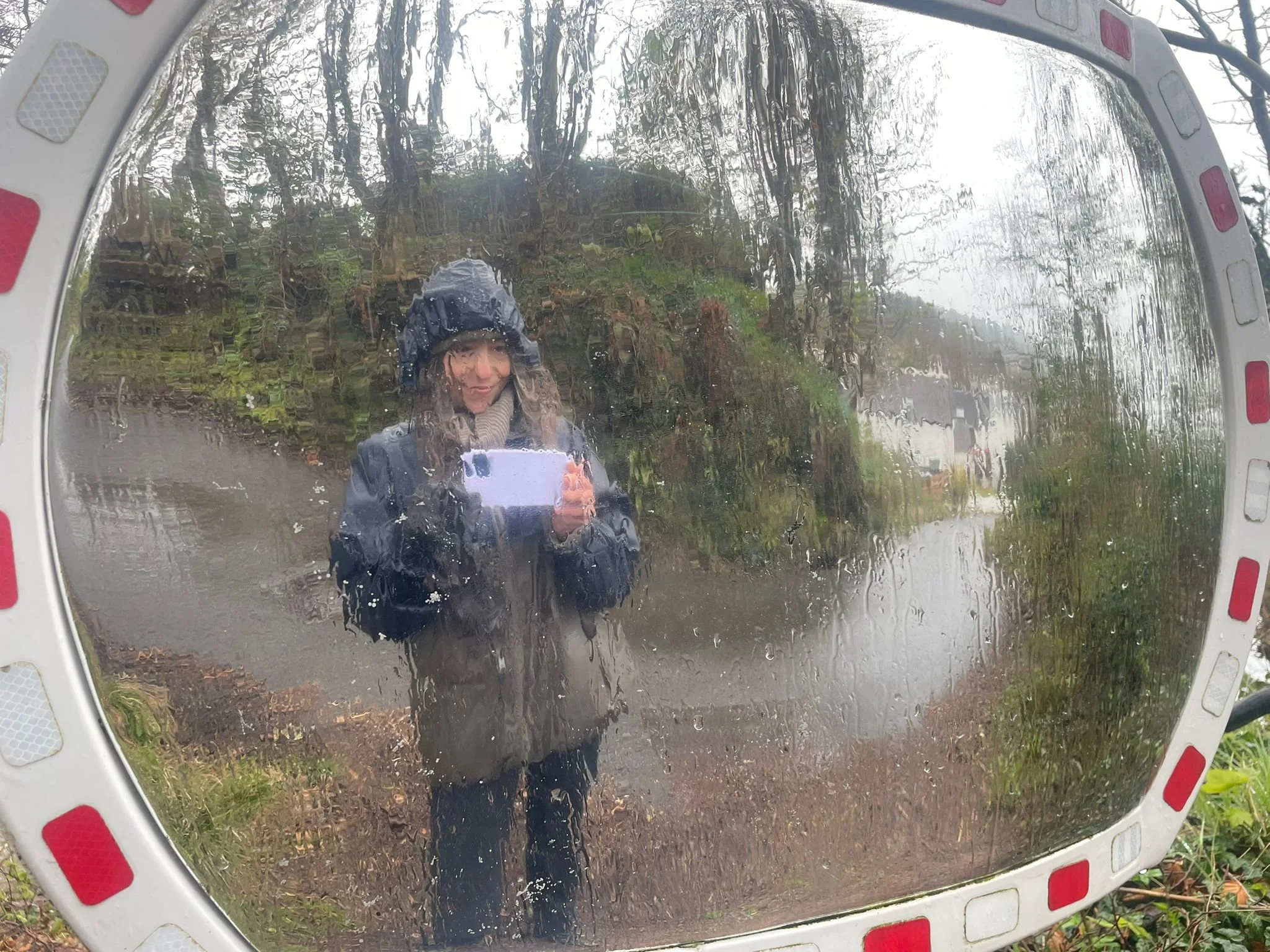
If you don't like the Arran weather, they say that you just need to wait a short wee while...
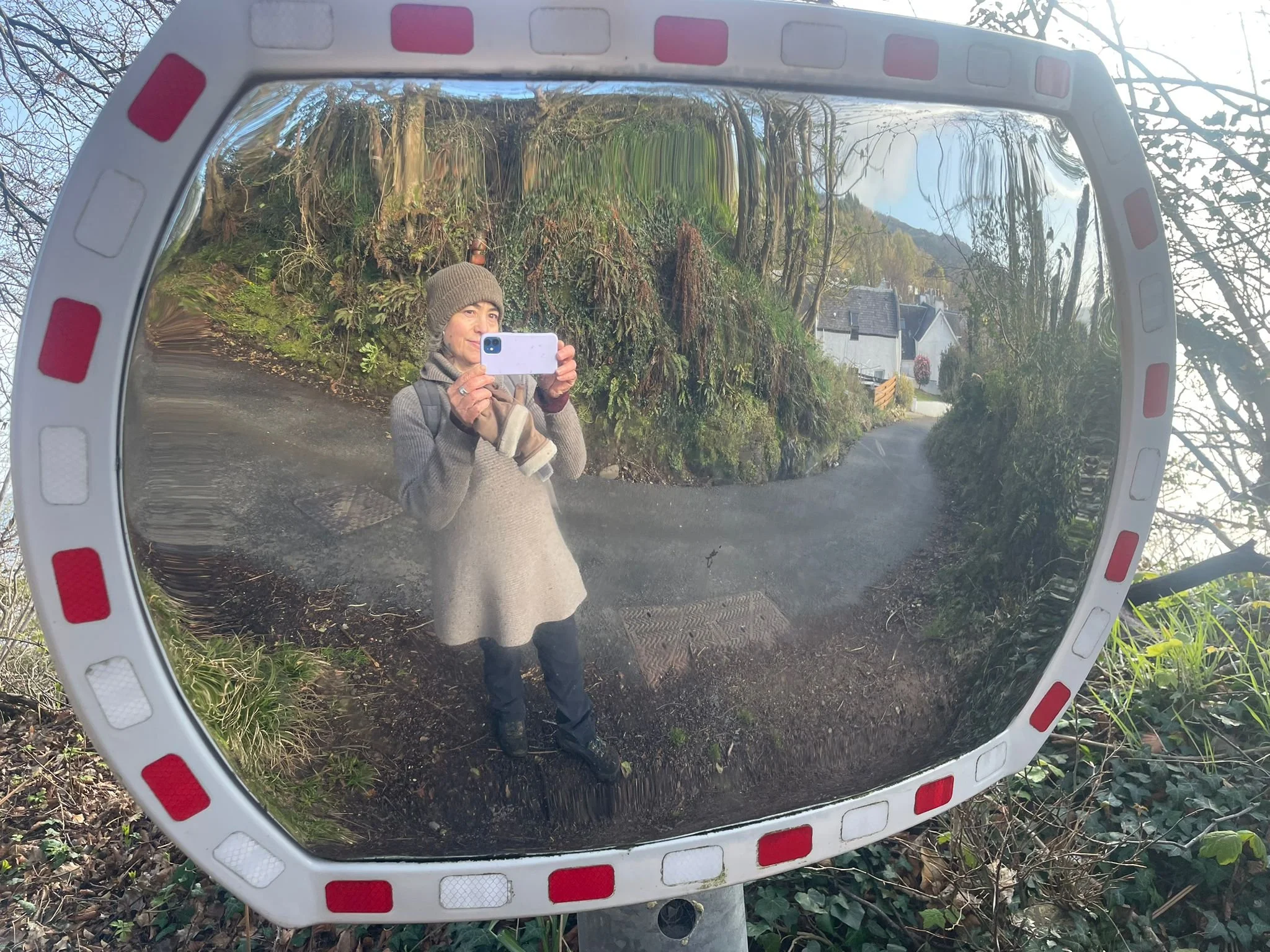
What a difference a day makes!
(A glorious morning, Smiddy Brae bend)
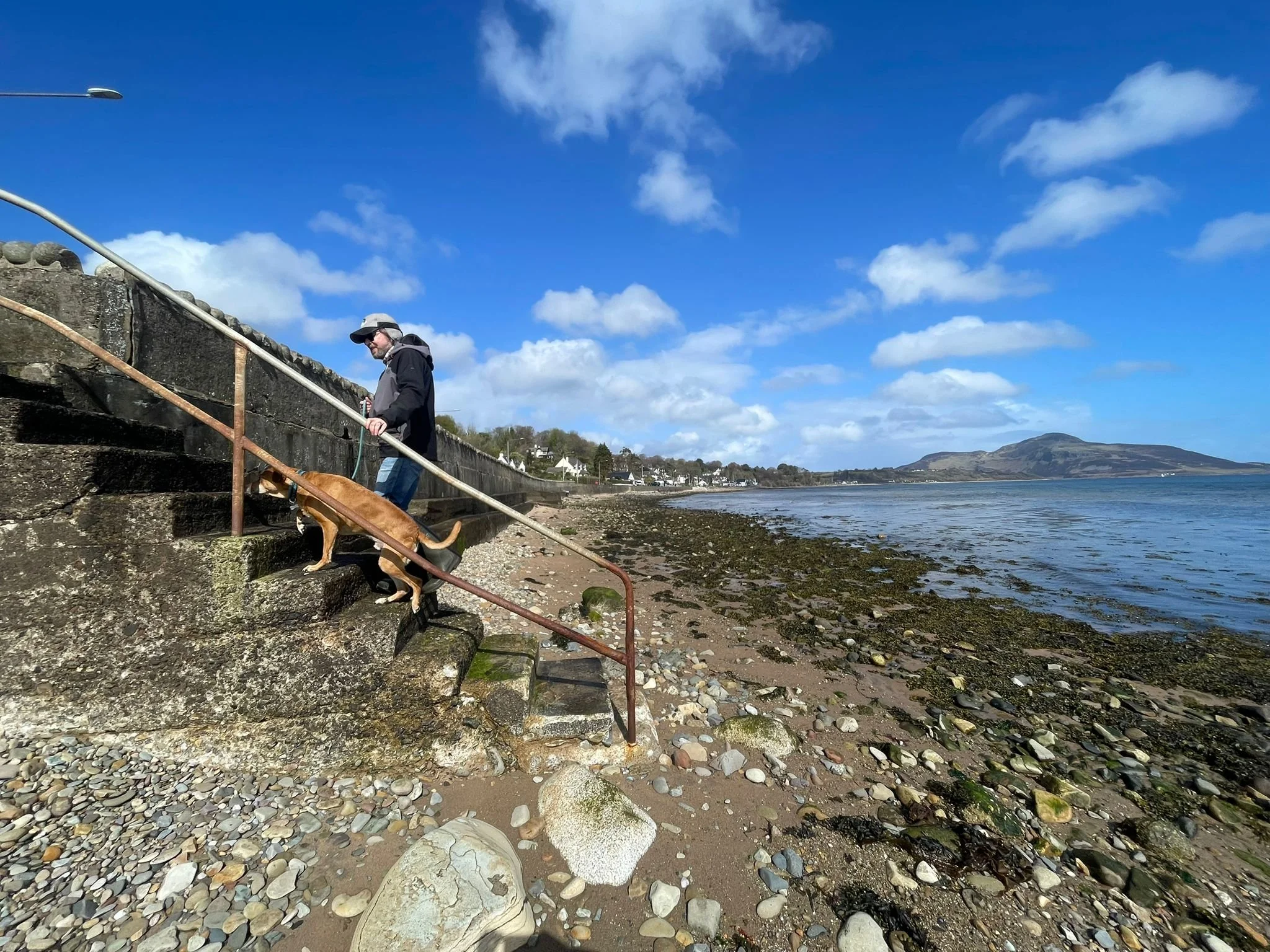
Red Barn Bluebells
(Dartmoor, May 2026)
For me, one of the main attractions of landscape photography - the thing that really gets me out of bed in the morning - remains the quest for that ‘original composition’. It might be a quirky abstract, an undiscovered vista, or a familiar subject viewed in a new, unusual way. Whatever the muse, the aim is to create an image - a mini view of the world - that few people will have seen before.
That being said… there are times when it’s best not to be too precious about such things. After all, classic scenes and honeypot locations are generally iconic for a reason. So if my composition below seems strangely familiar - or if you’ve simply had your fill of bluebell seas and red-roofed barns - please don’t judge me too harshly! ;-0
Actually, I did spend some time searching for a more original angle - as my long-suffering Dartmoor companions will testify - but on this occasion, the stars (or rather, the sun) simply didn’t align. Still, when a place displays such vivid beauty, it’s always good to find an excuse to return (of which more later!).
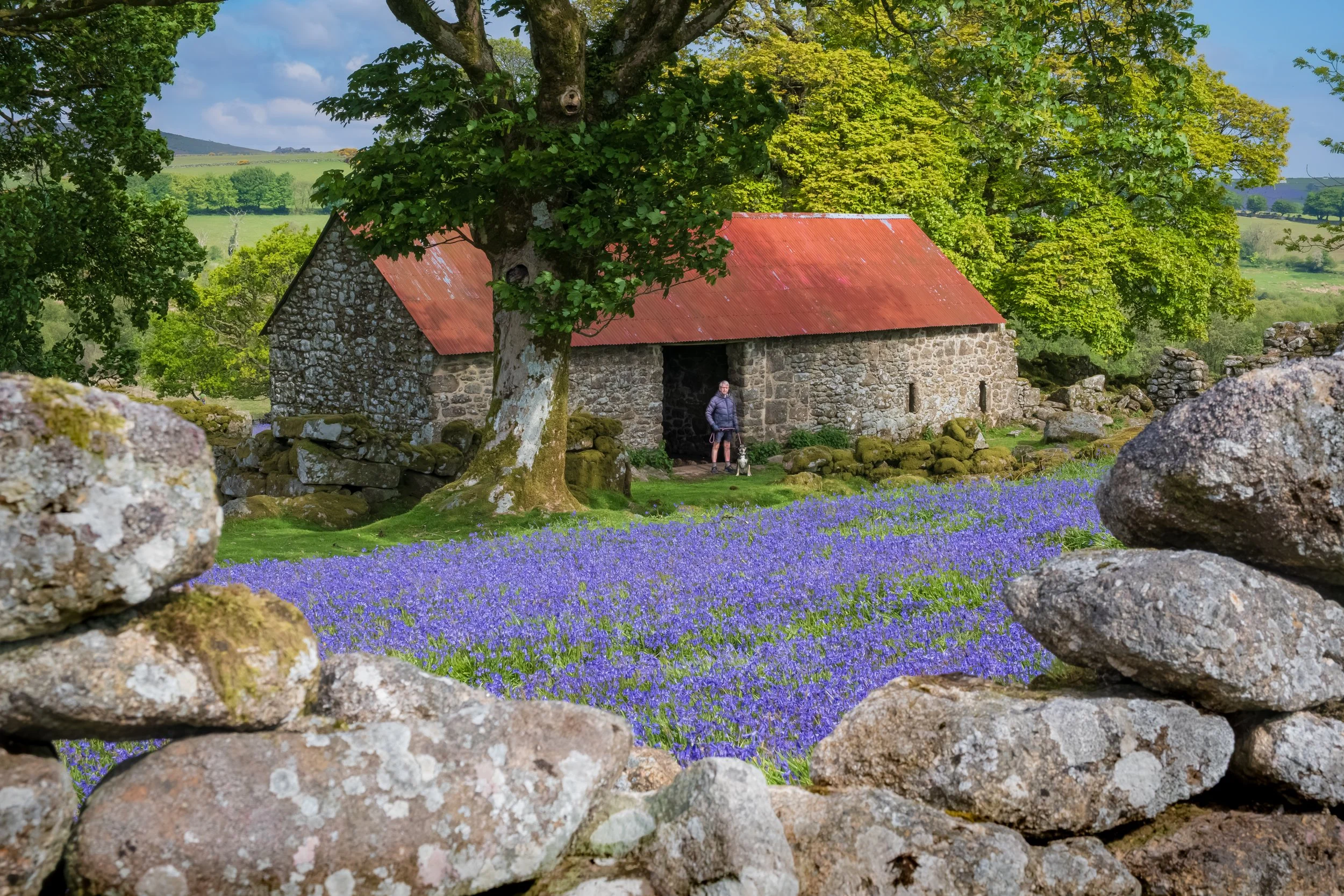
Talking of long-suffering companions, I must thank my father Nigel and canine compatriot Moogie for indulging my request for models in my second (repeated) shot. Both versions are presented here, to cater for viewers who may or may not prefer their idyllic moorland barns to come with rustic residents included… ;-)
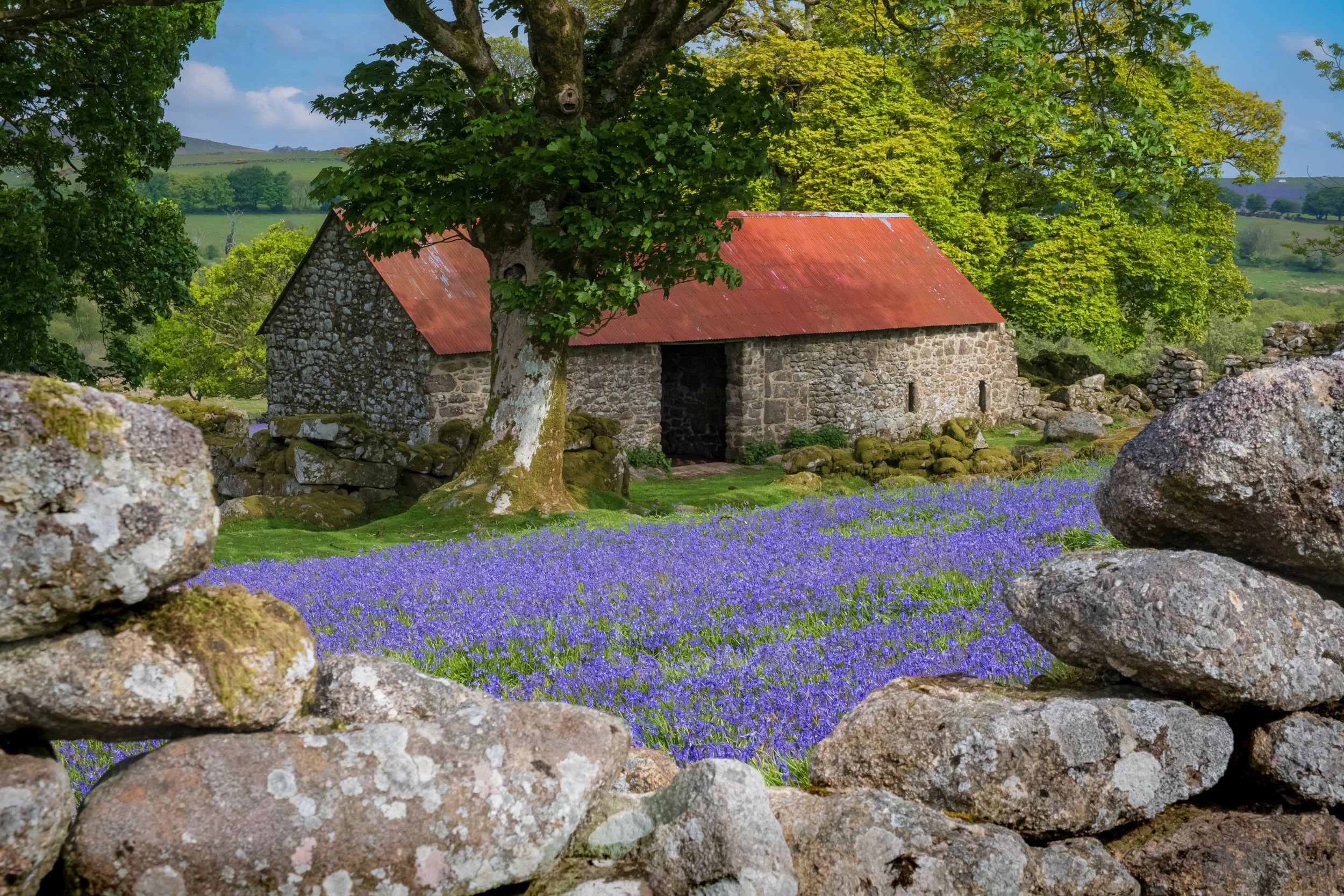
Spot the Difference…
Where did those bluebell-loving rustic residents come from?
(Presumably from the Red Barn itself?)
Red Rooves, Blue Bells - A Cautionary Note on Colour and Vibrancy
I must admit, I’m usually slightly wary of scenes which rely on particularly vivid colour… sunsets, say, or rainbows. And yes, splashes of bluebells.
These are clearly iconic subjects, which are a joy to witness and to shoot. Yet, for the modern digital photographer, they lead to a dilemma: how to apply post-processing in a measured fashion, to showcase the natural wonder without over-doing the saturation and making the scene look artificial.
One obvious solution - used by most as a default - is to simply let the camera decide, and go with whatever the built-in digital algorithms think we want to see. And that’s fine, of course. For frequent or casual shooters, it’s certainly the most pragmatic option. But it doesn’t account for the photographer’s artistic vision, or allow for the image to be moulded by our personal creative choices. And for those shooting in RAW format (such as myself), the camera’s information-rich yet flat-looking files do need some form of caressing just to bring the images back to what we might call ‘reality’*.
*What we actually mean by ‘reality’ is a separate discussion, which I won’t go into here! :-0
The trouble is, when the perceived quality of a scene is determined by the magnificence of colour - how vivid is that sunset, how striking the rainbow - then the temptation is to continue cranking up those sliders until reality is flailing somewhere in the rear-view mirror. And if we massage the colours gradually enough, conditioned by the picture-perfect super-shots of social media and AI, we might not even notice it happening.
It’s a rookie mistake… but unfortunately, one that I’m still guilty of making! :-(
Let me just say, though - unless you’re a photojournalist (or some other form of documentary photographer), there is room for post-processing to exhibit artistic expression. Art has no rules, so choosing to make your colours ‘pop’ can be just as valid and rewarding as choosing black & white… provided (I believe) we do so in good faith. Pop art is knowingly vibrant, for example, yet few would call foul (even if it isn’t to everybody’s taste). The problem, I think, is when the manipulation is a little more insidious, leading to images which purport to reflect reality but either mislead or fail miserably in the attempt.
In terms of my own trip to the Red Barn bluebells… one of my main aims on photoshoots is to convey (with intent) how a place makes me feel. Colourful and vibrant are certainly adjectives which spring to mind at such a special location, whether applied literally or metaphorically. To illustrate this in the field, I waited patiently for the sun to break through the Dartmoor cloud and illuminate the scene… and then, yes, I also strove to make the colours ‘pop’ somewhat during my post-processing in Lightroom. Viewing the resulting edits on my laptop, I felt I’d pushed the envelope just enough, reaching the edge of what I could (or should) reasonably present.
But here’s the sting in the tail, which has prompted this whole ‘colourful’ aside. Upon completion, I’d posted my Red Barn images to a private family chat on WhatsApp, and happened to be looking over Karen’s shoulder when they scrolled into view on her mobile phone. Although she kindly declined to say so, I immediately thought they looked over-saturated, especially in those dominant reds and blues. Capturing the vivid character of a place is one thing… but had I simply pushed it too far, only to have this revealed to me once I could view the images through somebody else’s eyes?
Well… maybe. Except, they didn’t look quite so bad when revisited at source on my laptop. And I’m probably late to the party with this, but it led me to investigate the difference (on average) between laptop screens and mobile phone displays.
Sure enough… mobile displays are generally brighter and more vibrant, using a default colour setting of Vivid rather than sRGB (standard Red Green Blue). I won’t go into all of the technical detail, especially as I don’t fully understand most of what AI threw at me! But suffice to say that an image calibrated for viewing on a laptop will appear quite different on most people’s mobile screens (and not just for obvious reasons of size). Those with cross-platform photography websites (mentioning no names) should obviously take note!
Of course, I do have the option of generating fresh (less saturated) Red Barn edits… but for now, I’ll leave what I have as a record of where my initial instincts took me. The thing that’s more valuable, I feel, is the underlying lesson: in photography, as in life more generally, things are not always as they first appear.
So what’s the upshot of all this? Well, if you happen to be viewing my Red Barn pics on a mobile (or any screen with a vivid display setting), and you feel I’ve over-egged the pudding, rest assured that part of me agrees with you. The other part of me says that I should follow the courage of my convictions, and give my own artistic vision - my post-processing stamp, if you like - some space to breathe. Either way, I obviously can’t control inherent differences in display settings. What I can do is be more conscious of that wise old adage (another lesson in life): sometimes, less is definitely more! ;-)
Dartmoor Déjà Vu - Return to the Red Barn Bluebells
Now the spring bluebell season is necessarily brief - and I’ve mentioned above that my initial visit to Red Barn didn’t really yield the type of original composition that I’d hoped for. So perhaps inevitably, I found myself returning to Dartmoor a week later… this time in the evening, when the westerly light would be more conducive to the quirky angle that I’d coveted (but reluctantly rejected) last time. And if I needed to lie in the dirt (or worse) to make this angle happen, then so be it… such is the country photographer’s lot! :-0
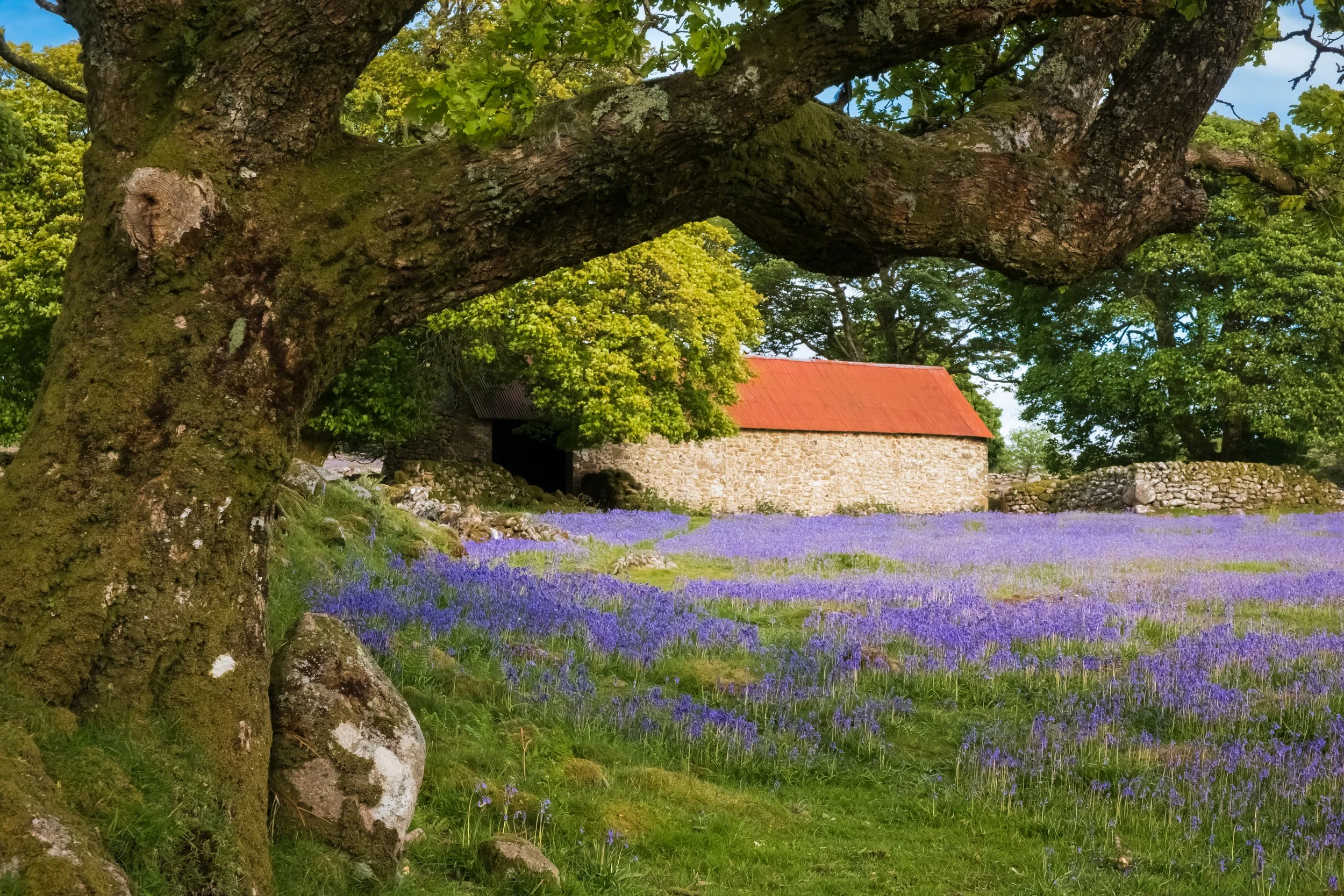
Framing the Red Barn…
On this occasion, using a gnarly old oak - less conventional examples pending!
My immediate environs - an area known as Emsworthy Mire - forms a dip in the high moor, a rich wetland habitat which is rightly celebrated for its fauna and flora (not least those vibrant bluebells), its high-pasture farming heritage (witness the Red Barn), and its surrounding granite outcrops (the most prominent of which form spectacular tors). In the spring, photographers naturally focus on bluebells and barn. Yet on my earlier visit, something else had caught my eye: those granite dry-stone walls which delineate the rough-hewn fields, as though salvaging an unlikely rural haven from the mire and moor.
Now these particular walls may be a little higgledy-piggledy in places - that’s all part of the rustic charm - but there’s clearly an art to their creation. In fact, calling dry-stone walling an art underplays the back-breaking labour - the skill and dedication - that evidently underpins it, especially when undertaken in such a hostile environment. Hereabouts, some of the building blocks are huge granite slabs rather than stones… and it’s intriguing to think that those fertile bluebell-laden meadows only exist because the moor’s natural clitter has been gathered up and arranged into intricately-balanced field boundaries.
If these weathered walls do appear slightly tumbledown in places, it’s a wonder that the winter winds don’t blow them down entirely. And one reason this doesn’t happen is that, whether by accident or design, small gaps between the granite blocks allow the worst of the gusts to squeeze through unhindered.
Of course, for the restless landscape photographer, these ‘holes in the wall’ also offer intriguing foreground opportunities. And I do love some decadent framing! Now I’m pretty sure that particular property of the wall is accidental… but we shouldn’t look a gift horse (or even a Dartmoor pony) in the mouth! ;-)
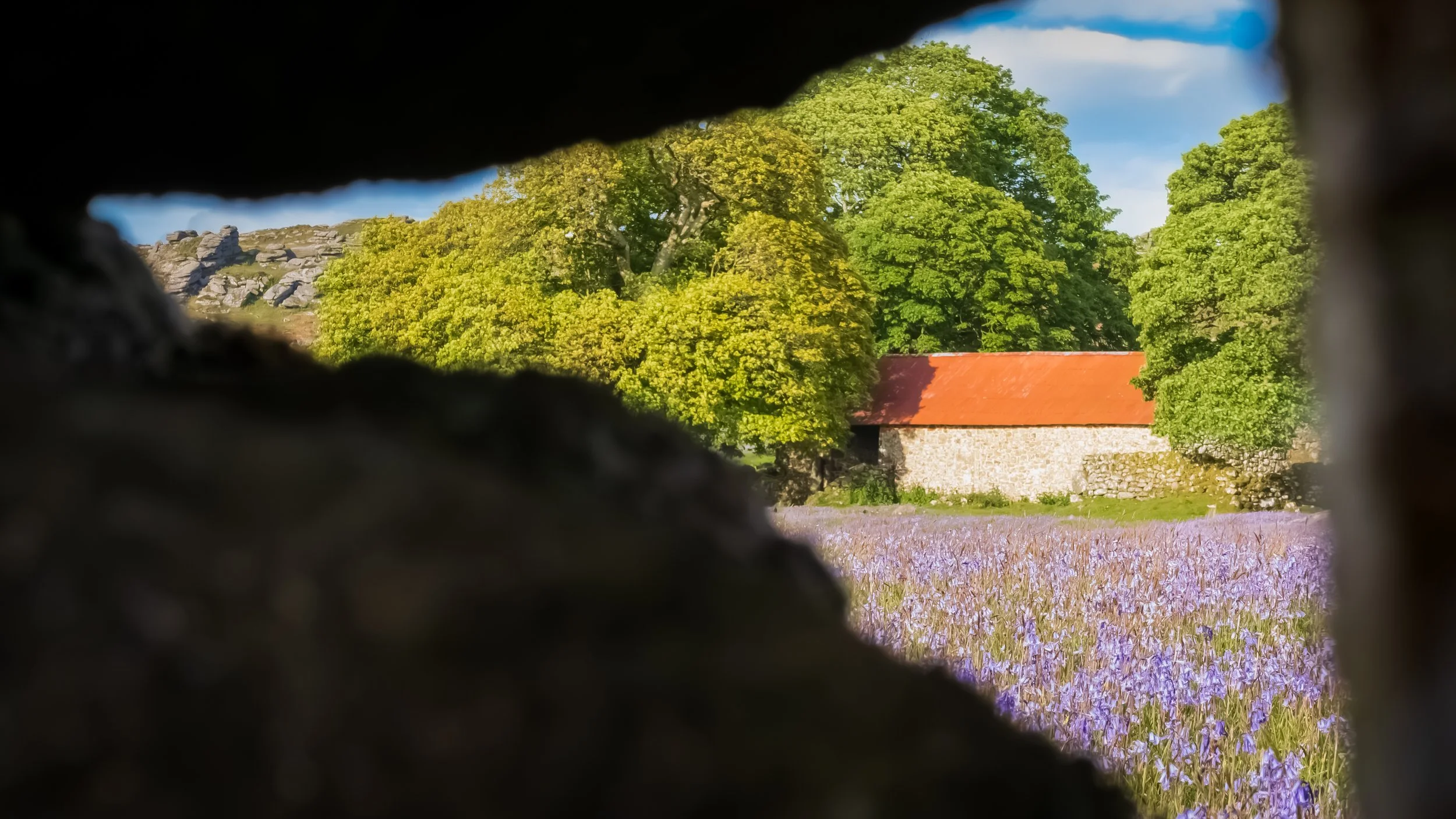
‘Through the Keyhole’ - Glimpsing Bluebells and Barn…
An experimental ‘sneak peek’ through the abstract crevasses of a bounding dry-stone wall
Re-inventing the ‘Hole in the Wall’… Dartmoor-style!
If the modern meaning of ‘hole in the wall’ implies a gateway to riches, then this is even more true of the literal Dartmoor versions presented here! But cheesy metaphors aside, the idea of foreground framing is something that I often return to in my photography, from caves and rock fissures to tunnels and branches. I think this works best when the foreground element - despite being deliberately out of focus, and usually verging on blackness - is not just a random vignette, but actually serves as an integral part of the scene.
In the case of these Dartmoor ‘holes in the wall’, I’ve already outlined the way in which these rough granite boundaries - assuredly man-made, yet being aptly reclaimed by nature - add such rich texture to this historic corner of the moor. Yes, in one sense they offer a simple framing mechanism. But to be more esoteric, you can also think of these vistas as representing the ‘view of the wind’ as it whistles invisibly across the mire.
Talking of invisibility, I must again thank Nigel, my father and local tour guide, for accompanying me on this return visit. We waited out a cloudburst together before approaching the bluebell meadows (marvelling at a rainbow on the way)… and although he doesn’t feature in any photos this time around, his strategically-positioned shadow helped to manage that pesky foreground glare. Moreover, as I struggled to micro-adjust my camera with head stuck in a wall, it was Nigel who spotted that subtle bird-on-a-rock in the shot below…
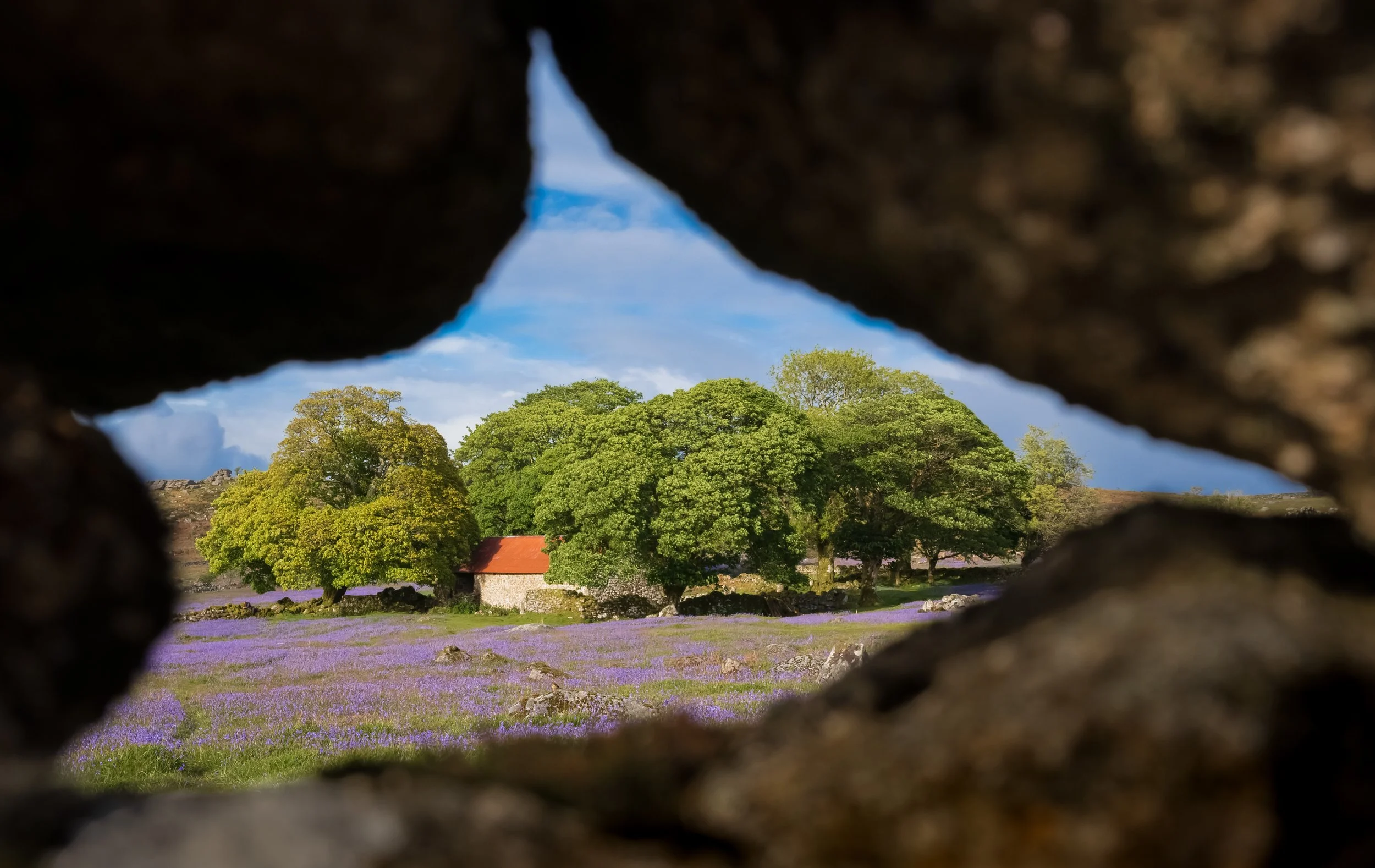
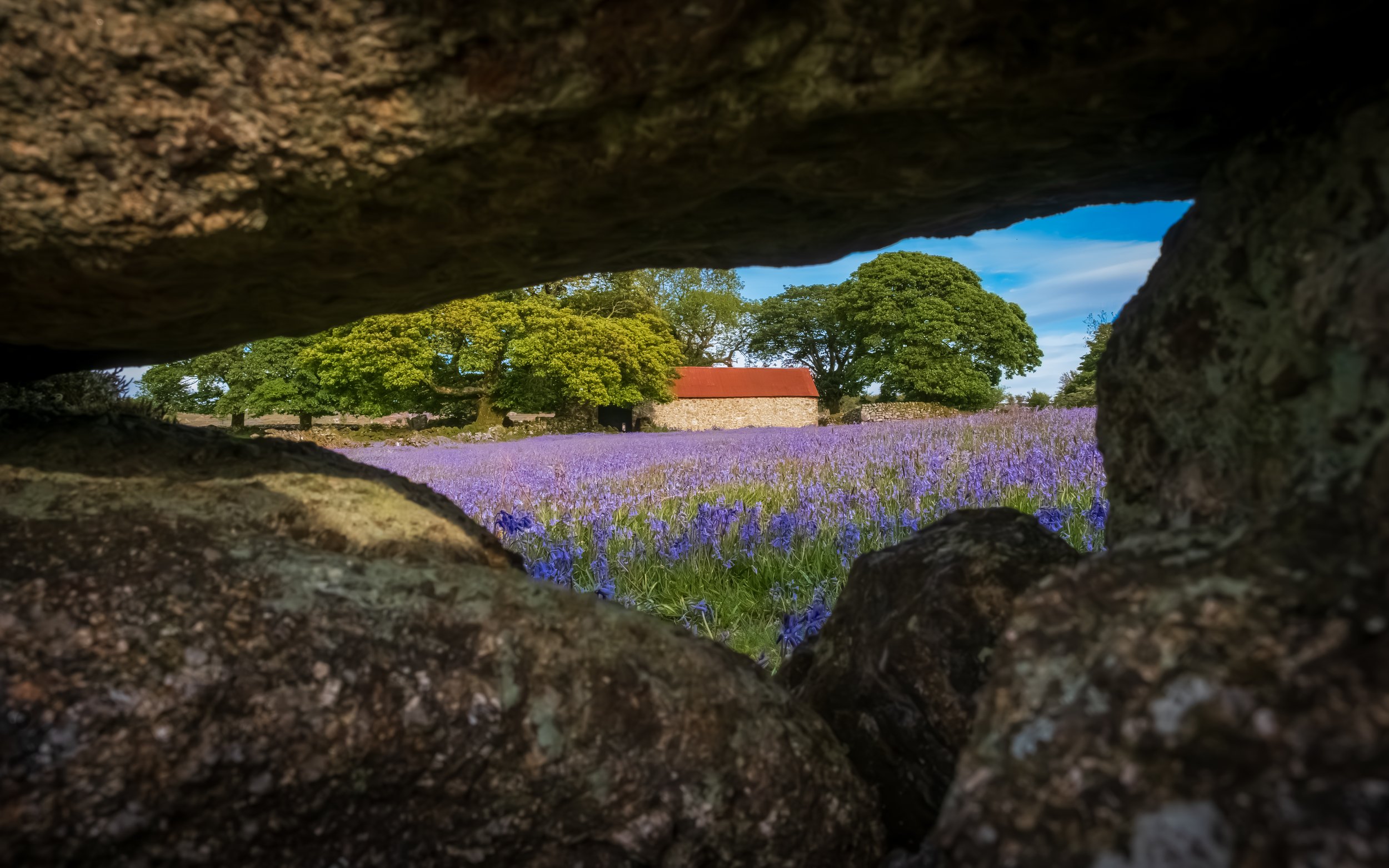
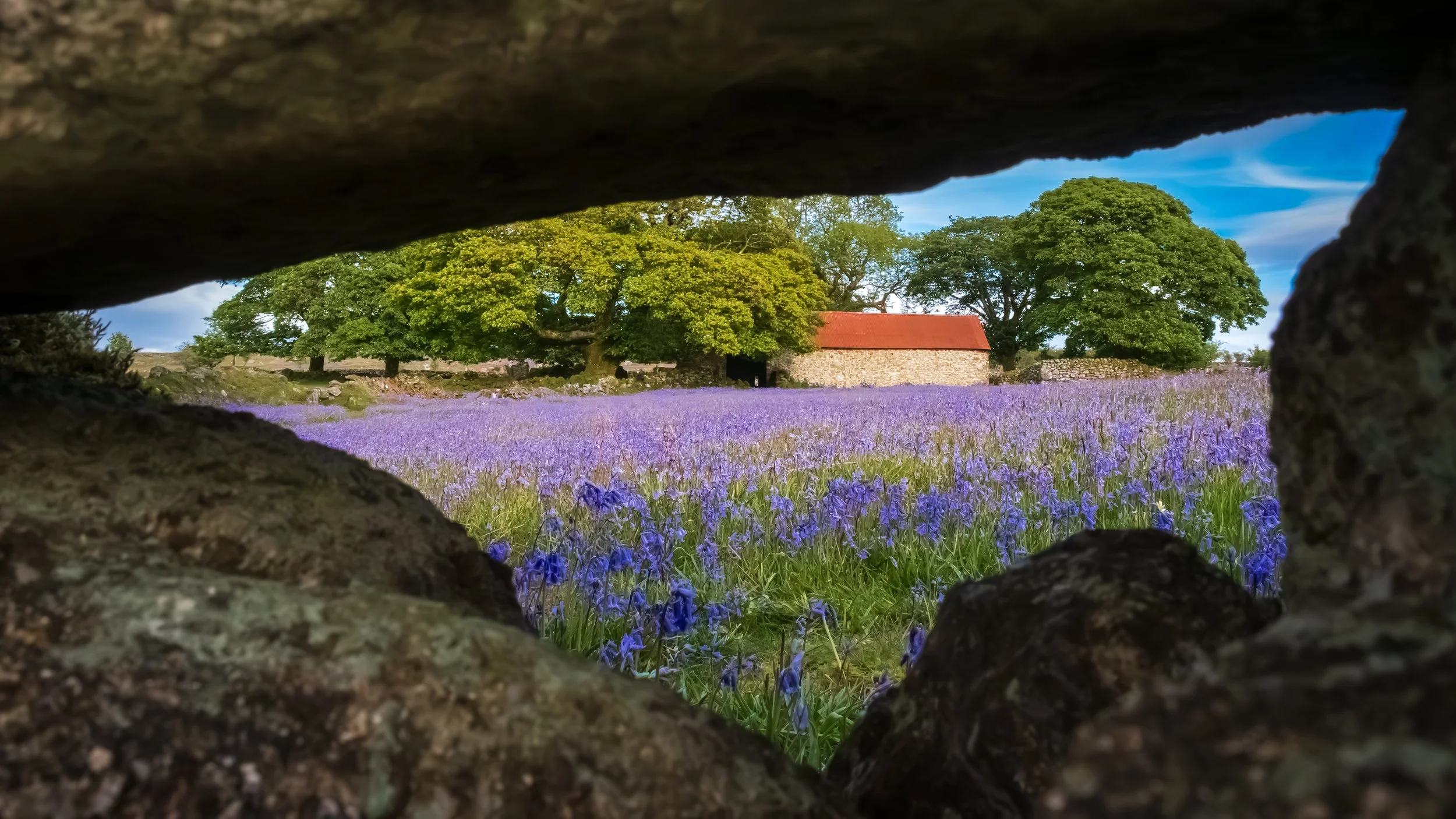
From Crazy Stars to Dartmoor Letterboxes*…
The Red Barn rolls out its Blue Carpet, as seen through ‘Holes in the Wall’ of various shapes and sizes.
*As some of you will know, ‘Letterboxing’ - the search for makeshift letterboxes concealed amongst the granite of prominent tors - is a ‘thing’ on Dartmoor;
I wonder whether the quest for letterbox-shaped frames could offer an equivalent challenge for meandering landscape photographers? ;-)
The Ancient Oak of Uffculme
(Devon Countryside, June 2026)
I would soon be leaving sunny Devon for more northerly climes… but before going, in amongst all of the removal chaos, I did want to honour a local landmark - a kind-of living legend - which I’d never previously visited.
Some say that the Ancient Oak of Uffculme is a thousand years old. Nobody knows the precise age, though it’s clear that this wizened old character has seen the turning of many seasons and the passing of many generations. On this particular summer morning, the faffing of a clumsy photographer in a nearby tangle of roots must have barely warranted the creak of a bough. For while I scrabbled in the dirt, it was humbling to think that this historic wonder of nature not only remains standing, but is still sprouting leaves. Long may this continue, even after our petty day-to-day concerns have inevitably turned to dust! ;-()
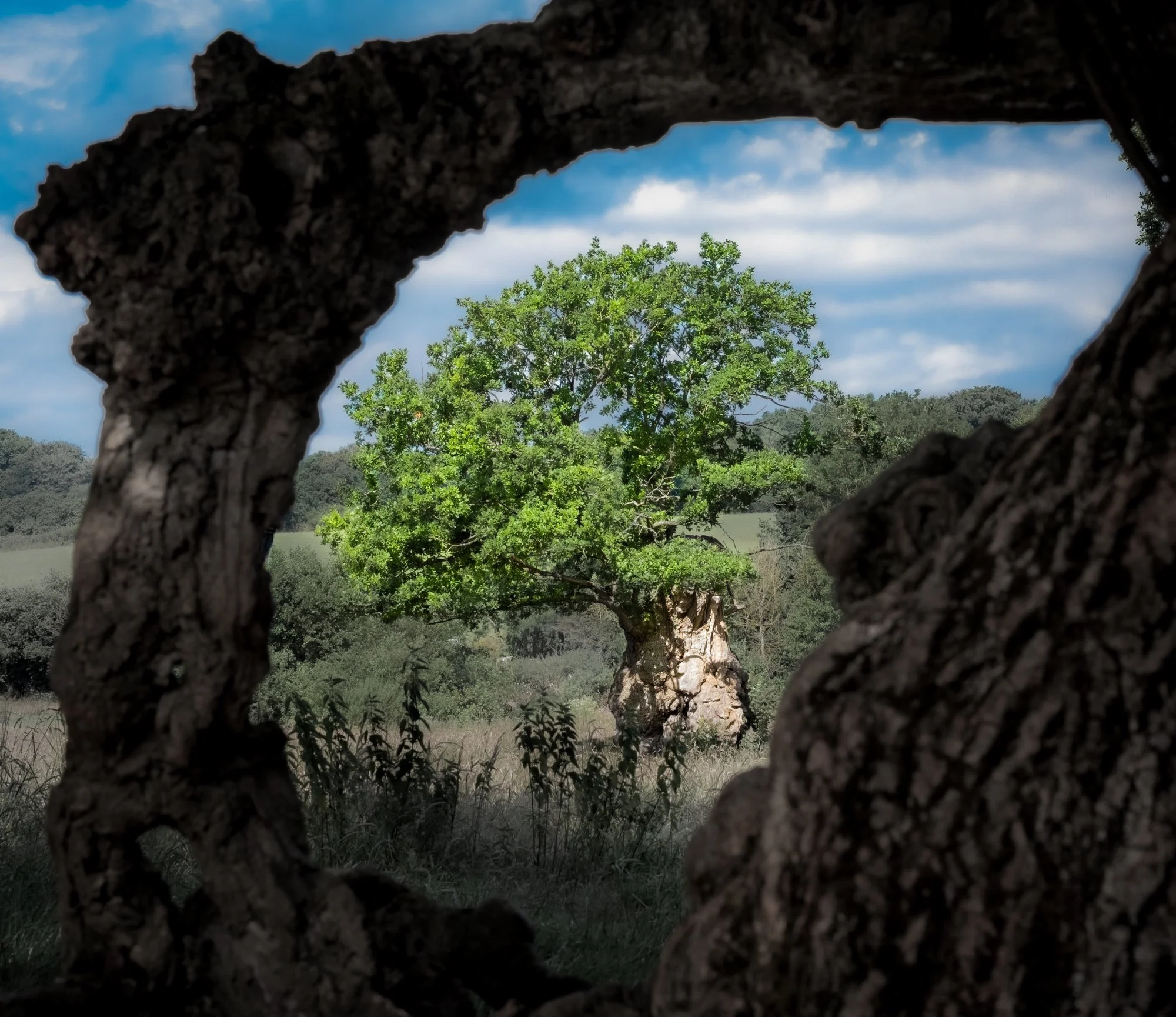
Peeping Through the Millennia…
The Ancient Oak of Uffculme
(Somewhere in Deepest Devon)
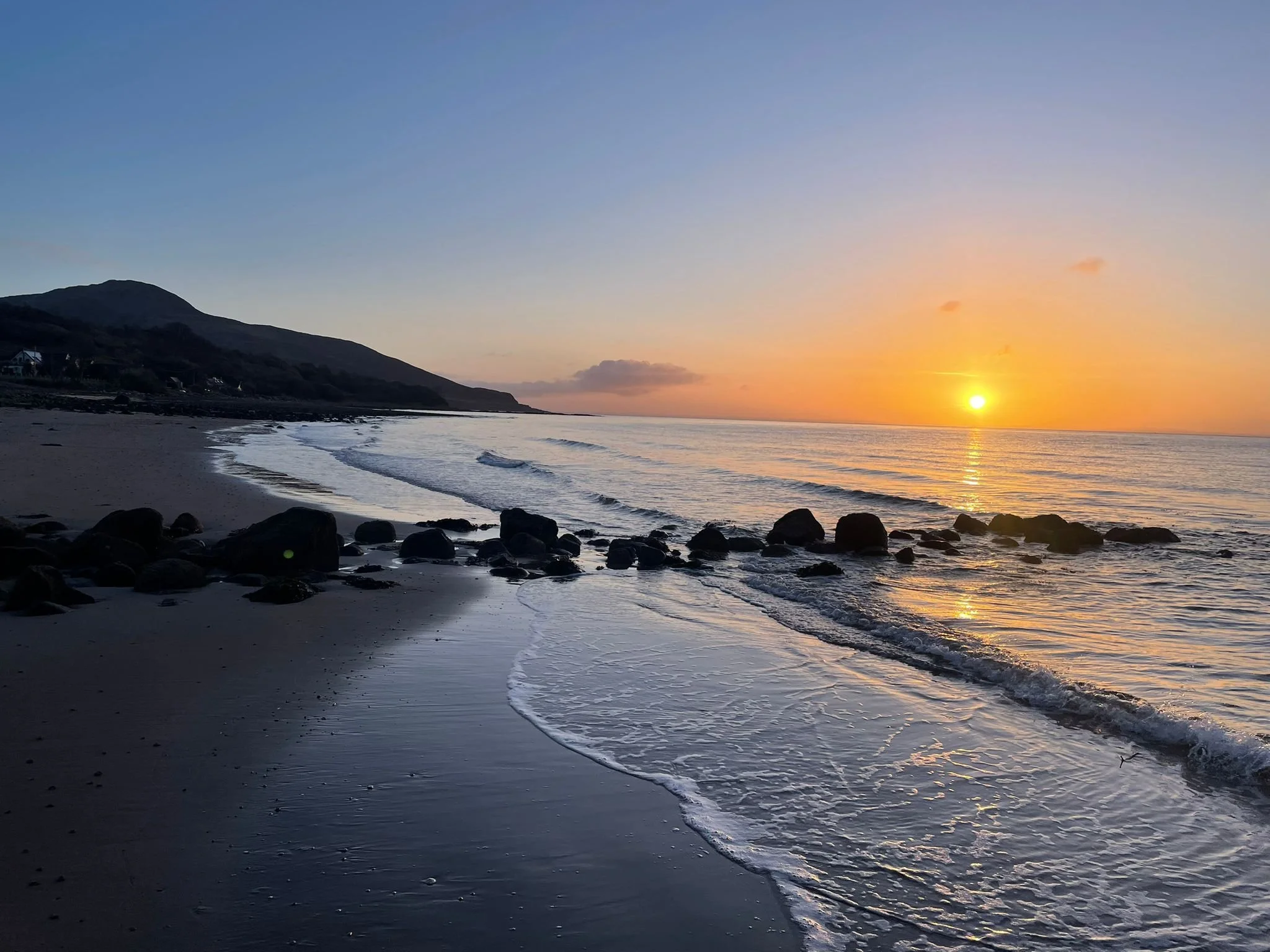
Caledonian Dawn
(Lamlash Bay, August 2026)
I’ve mentioned the Summer 2026 removal chaos, and it really was. But the key thing is, we finally made it… all the way from Devon to Arran. Come late July, we could at last declare: Mission Accomplished! :-)
For me, one of the most exciting aspects of our move was the thought of having so many amazing photographic subjects - that stunning Scottish scenery and subtly dancing light - right on our doorstep. Yet paradoxically, the move itself was so pervasive, so all-encompassing, that it proved to be a blocker to creative camera work. If your bag is photographing endless legal documents on a mobile phone, then great: you’ll be in your element. But as for those tantalising landscapes and seascapes… well, patience is the name of the game. Waiting for that ‘bigger picture’ to emerge from the bedlam of boxes…
Still, shortly after moving in, it was a joy to amble just a few yards from home to capture a high-tide sunrise over the Firth of Clyde. And yes, I was a little rusty - my long-exposure panorama techniques perhaps need fine-tuning - but what does that matter? Here before me, in gently swelling technicolour, was our literal and metaphorical Caledonian Dawn… :-0
Summer Sunrise - Lamlash Bay and Holy Isle
(Rooted on Arran at last!)
From Funnels to Tunnels
(East of Arran, September 2026)
Autumn Arrivals (Comings & Goings at Balmy Brodick)
While September continued to be a ‘settling in’ month after our big move to Arran, it also marked an opportunity to receive our first island visitors - friends and family - before the onset of the dark Scottish winter.
This isn’t really the place for holiday snaps, but I will include a couple mobile shots of CalMac’s Caledonian Isles as it respectively brings my parents to the island (looking ominously hungry!), and then - the following week - marks their bittersweet, rainbow-clad departure.
When visiting Arran, crossing the Firth of Clyde is all part of the adventure - however, it can be akin to running a gauntlet, with ferry cancellations commonplace as autumnal storms begin to sweep in. So our guests were grateful for the benign conditions seen here…
After the Storm - Our ‘Home Shore’ of Lamlash Bay
My landscape photography exploits had continued to take a back seat since moving to Arran, with the chaos of relocation giving way to visitor season. But come late September, a clearing band of heavy rain, combined with a scenic high tide, led to an afternoon on our local shore with camera and tripod in hand. My initial target - some intriguing clumps of semi-submerged ‘sea grass’ - soon gave way to a full, 5-pic panorama. I suspect these are practice shots rather than the finished article… still, it was great to be out there again! :-)
After the Storm - Lamlash Bay and Holy Isle
(5-pic panorama)
Eye of the Storm - Tunnel Vision in Lamlash Bay
Ever since house-hunting around Lamlash Bay back in April, I’d had one artistic eye on a small circular culvert which carried a wee burn beneath the road and emptied it onto the shore. Looking through such a tunnel can give striking results… and even though my enthusiasm waned slightly when I realised it failed to frame (say) Holy Isle, the concept continued to lurk at the back of my mind.
Fast-forward to the last day of September, and an unusually wild high tide led to an impromptu recce of this now-local culvert… which in turn became an ad-hoc photoshoot. In fact, the seaward end of the tunnel was being bombarded with such wave-lashed ferocity that I had to enter it from the landward side, by clambering down into the burn and weaving my way through the undergrowth.
Tunnel of dreams… looking back to landward!
Although mostly opportunistic, this turned out to be one of my more challenging photoshoots. Luckily I’d donned my natty fishing waders, which did a sterling job withstanding the surges of saltwater which charged right through the tunnel with each large wave. The main struggle was operating and safeguarding my camera and tripod, juggling filters which would surely have been swept out to sea if momentarily fumbled. Camera dials seemed to reset themselves in the mêlée, exacerbating the difficulty of exposing for the bright tunnel entrance or experimenting with abstract ICM (Intentional Camera Movement) techniques.
The upshot is that I walked away from the shoot, cold and dripping wet, thinking that I had no usable images at all. It was a nice bonus to find that some of the frames had come out after all (sort of)… the more abstract, the better! ;-)
Eye(s) of the Storm
(Three Black & White views of a wild & wind-lashed Lamlash Bay… some more abstract than others!)
Heron Highwater
(Lamlash Bay, October 2026)
OK, so I might not have literally gone through hell ‘n’ high water for these images… but they did involve lying around in the chilly outflow of a swollen burn, fine-tuning my compositions and awaiting the right kind of light.
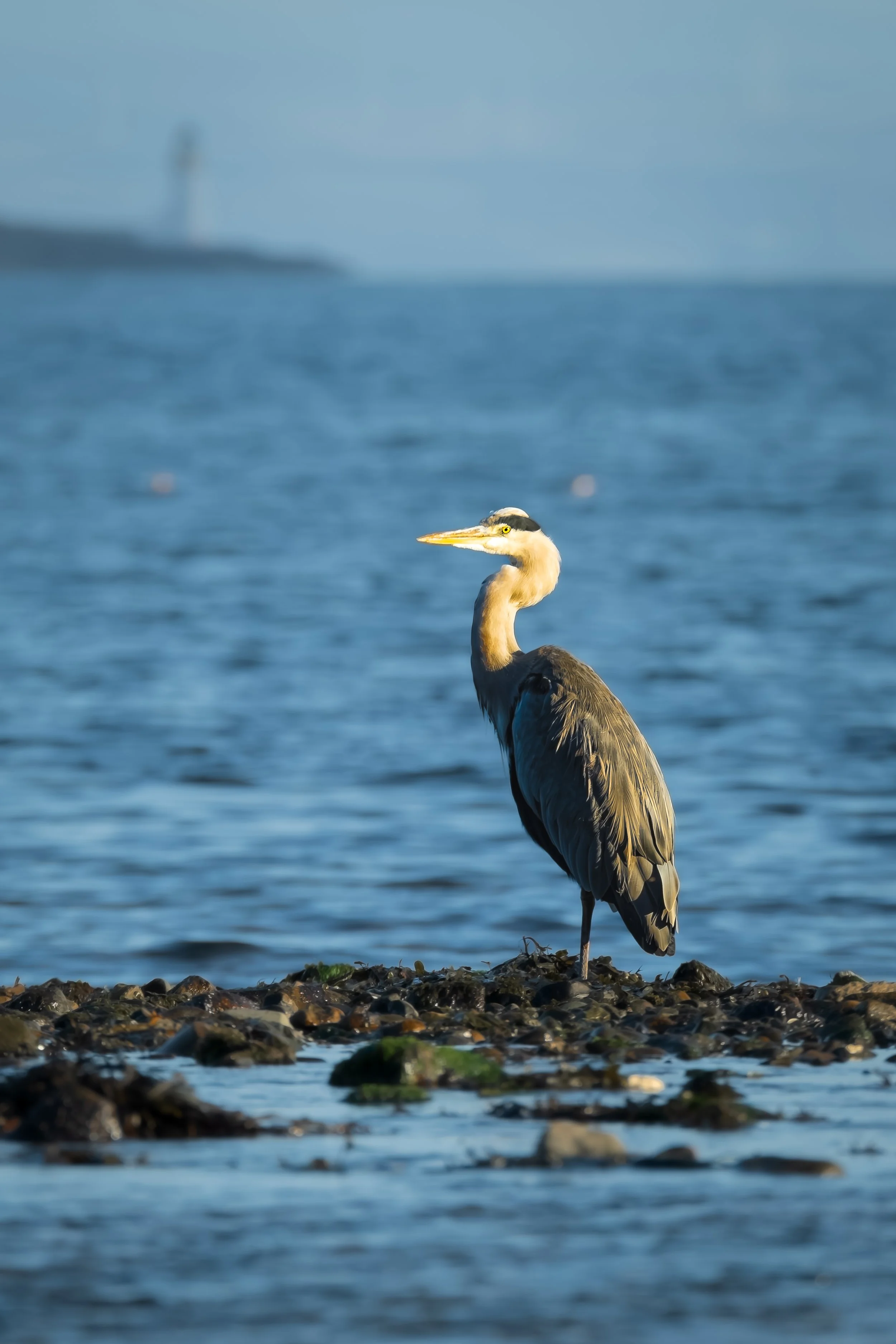
It’s appropriate that I was wearing waders, and not only for the obvious reason of staying warm(ish) and dry. For it was the chance arrival of another kind of wader - our ubiquitous local heron - which led to the serendipitous theme of this wee section (and indeed, to the really bad pun in its title). :-0
Despite the occasional dabble, I don’t really profess to being a wildlife photographer - so my original aim was a variation on what you might call a dynamic seascape. The burn’s foreground rapids would be my main subject, with the graceful form of Holy Isle bidding for the accolades in a scene-stealing supporting role. And in suitably moody conditions, I think that would be enough. Yet, with skies too blue and benign to call this a true film noire, I did feel some excitement when my photo-bombing bird swooped regally into frame.
The trouble is, I suspect this was more exciting to witness in person than to view in the actual photo (where the bird is barely visible, especially if displayed on a small mobile screen). No matter… once this was pointed out to me, I did return to the shore a couple of days later for a more suitable portrait of said heron, this time positioning myself in a different pool of cold water. Oh, the things I won’t do to justify a ‘punny’ section title!
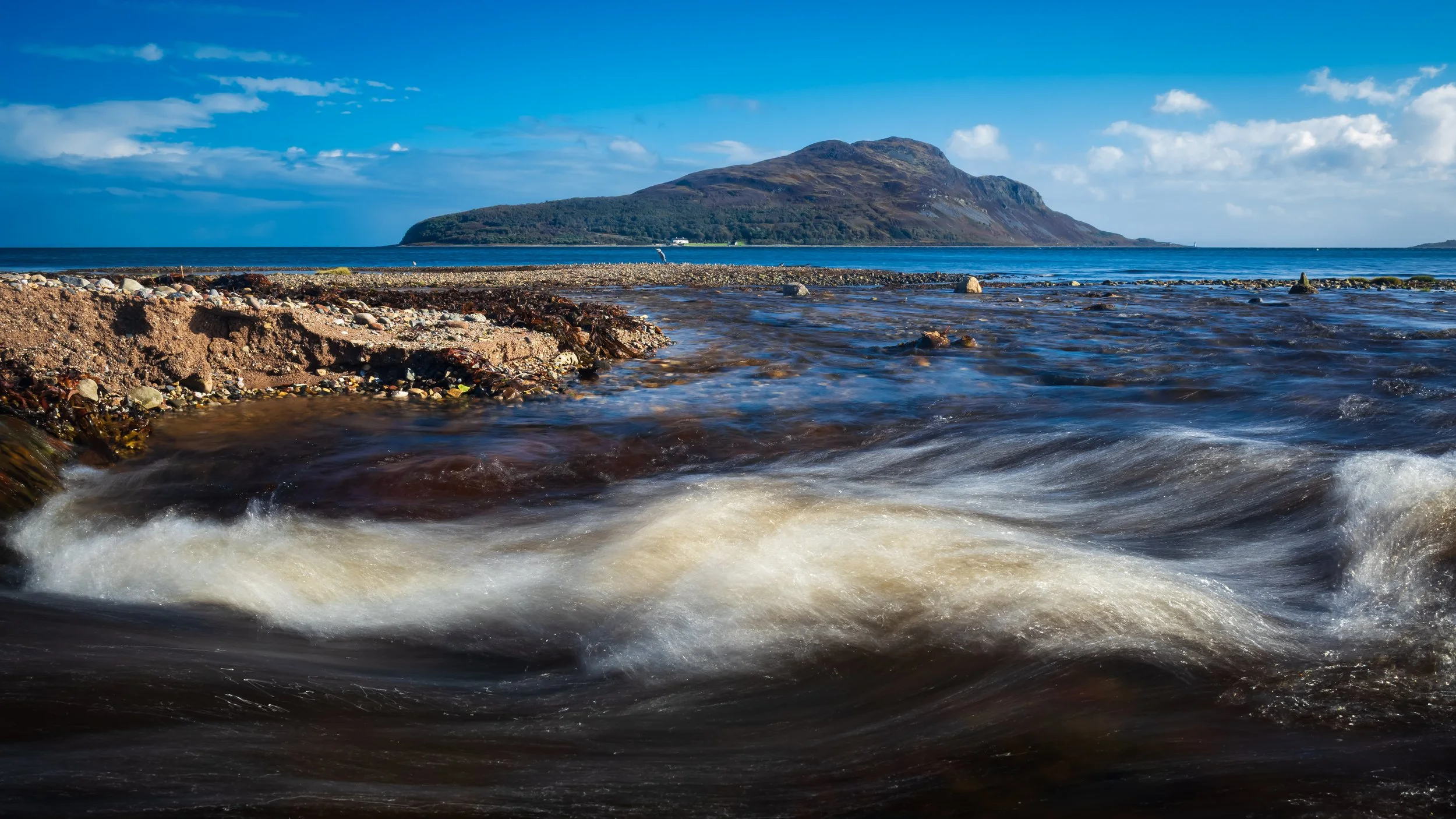
Heron Highwater
(Two variations on a ‘Holy Water’ seascape theme, with Hidden Heron…
and a subsequent telephoto shot in which the shy, retiring wader is finally afforded a turn in the spotlight!)
Black & White and Watery Light
('Clauchs & Glens', October 2026)
As the Arran Autumn progressed, I continued to pursue my muse of dynamic water - gradually moving from local seascapes (Clauchlands Point and Holy Isle) to the ever-changing chatter of hill and mountain burns. For the latter, I re-visited a couple of firm favourites: Glenashdale and Glen Rosa. Naturally, to facilitate such aqueous antics, I was accompanied at all times by my natty pair of fishing waders! ;-)
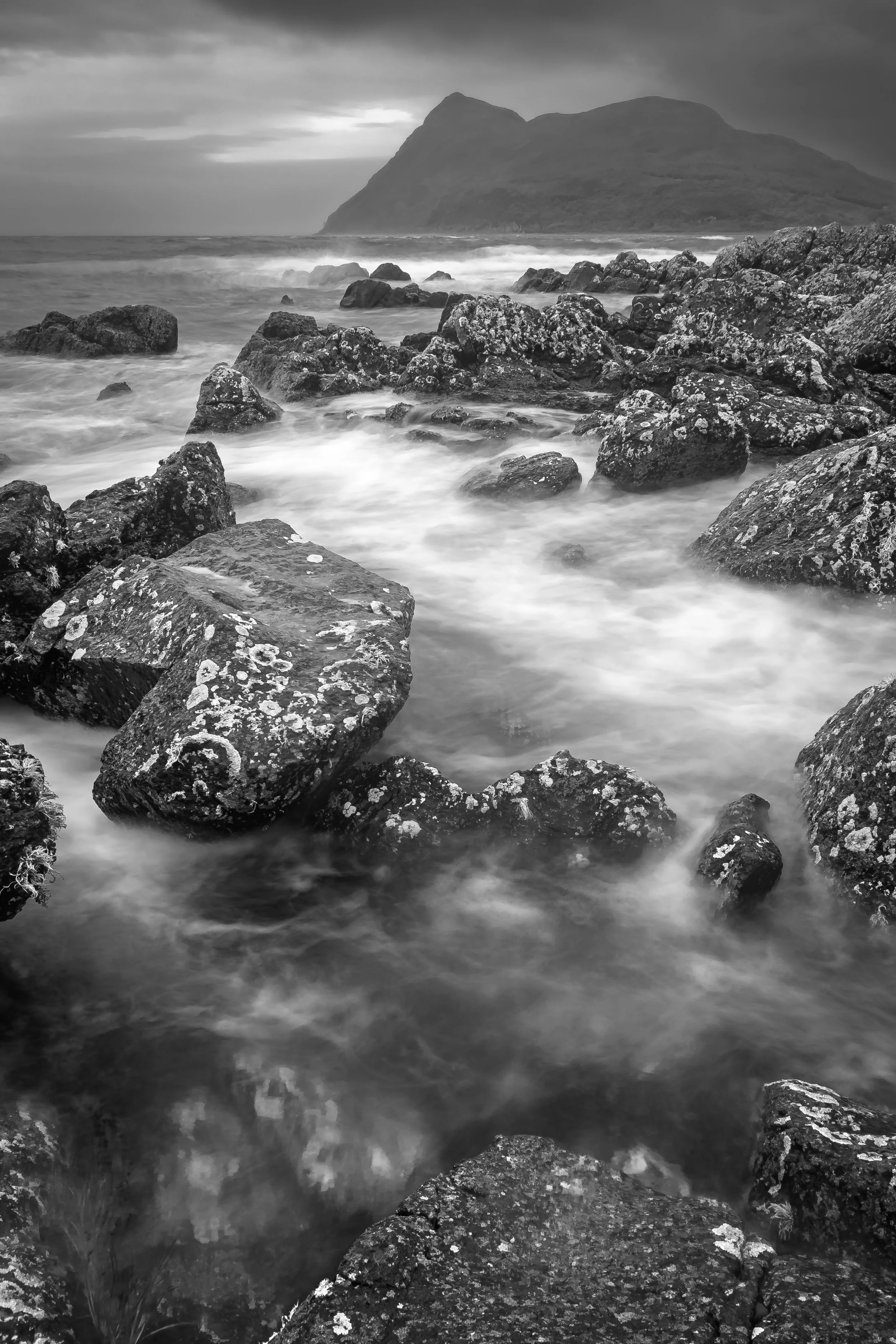
White Water, Grey Skies
(A Wild Day at Lamlash Bay - Capturing the ‘Holy Rollers’ of Clauchlands Point)
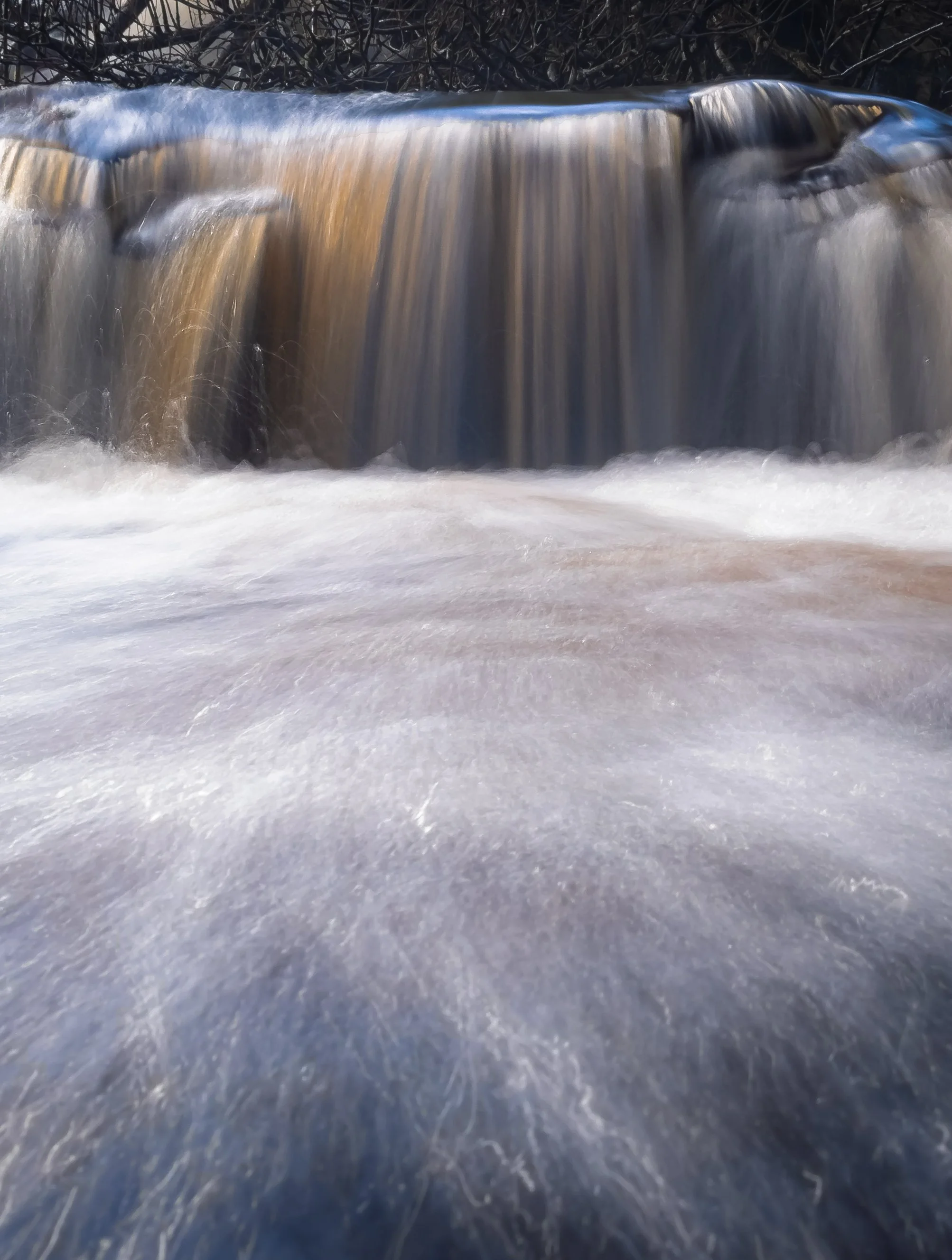
Buttermilk Burn
(Exploring the ‘Hidden Falls’ of Glenashdale, somewhere high above its Celebrated Cascades)
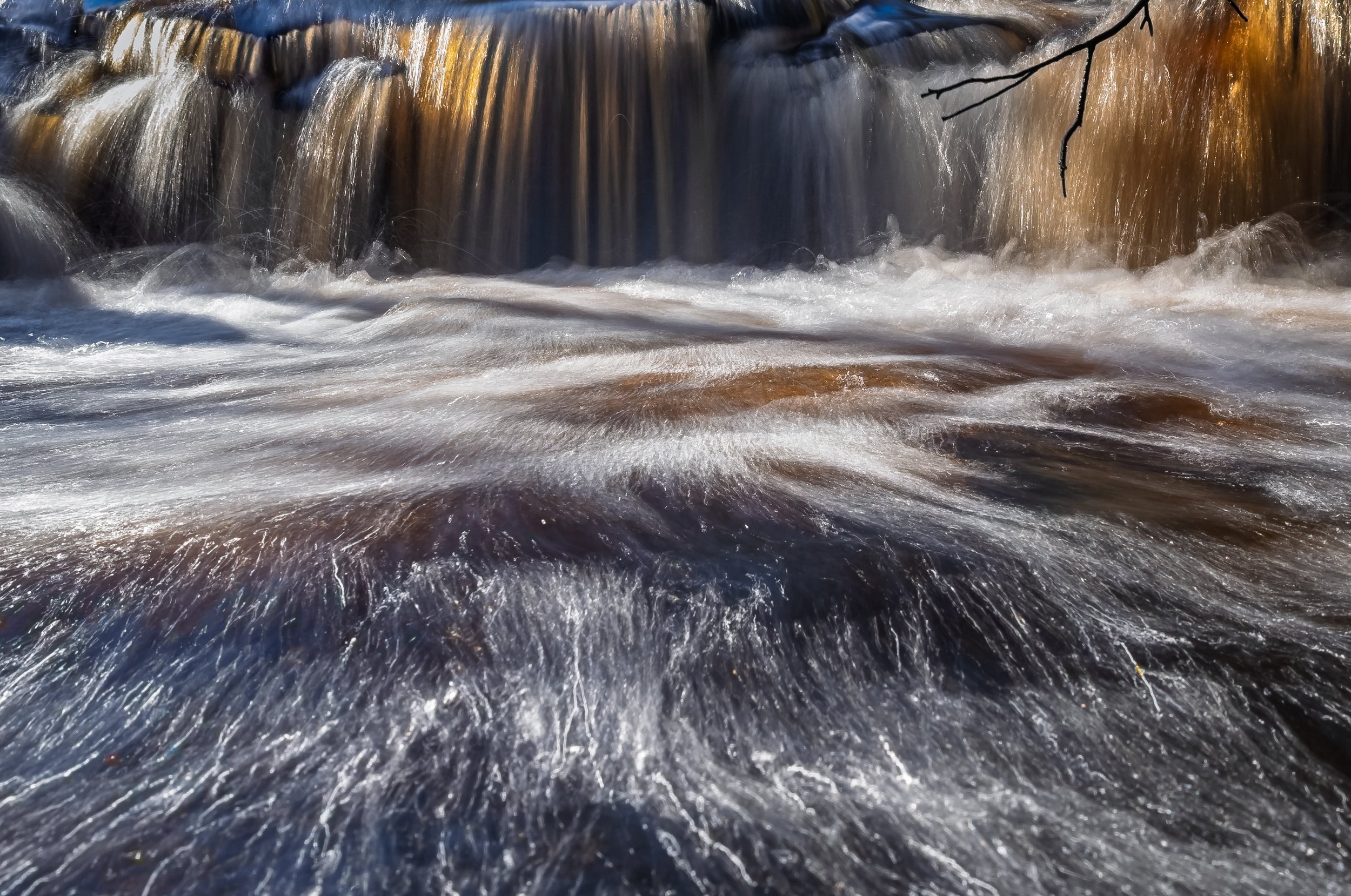
Texture and Twig
(An Alternative Take on Glenashdale’s Hidden Falls)
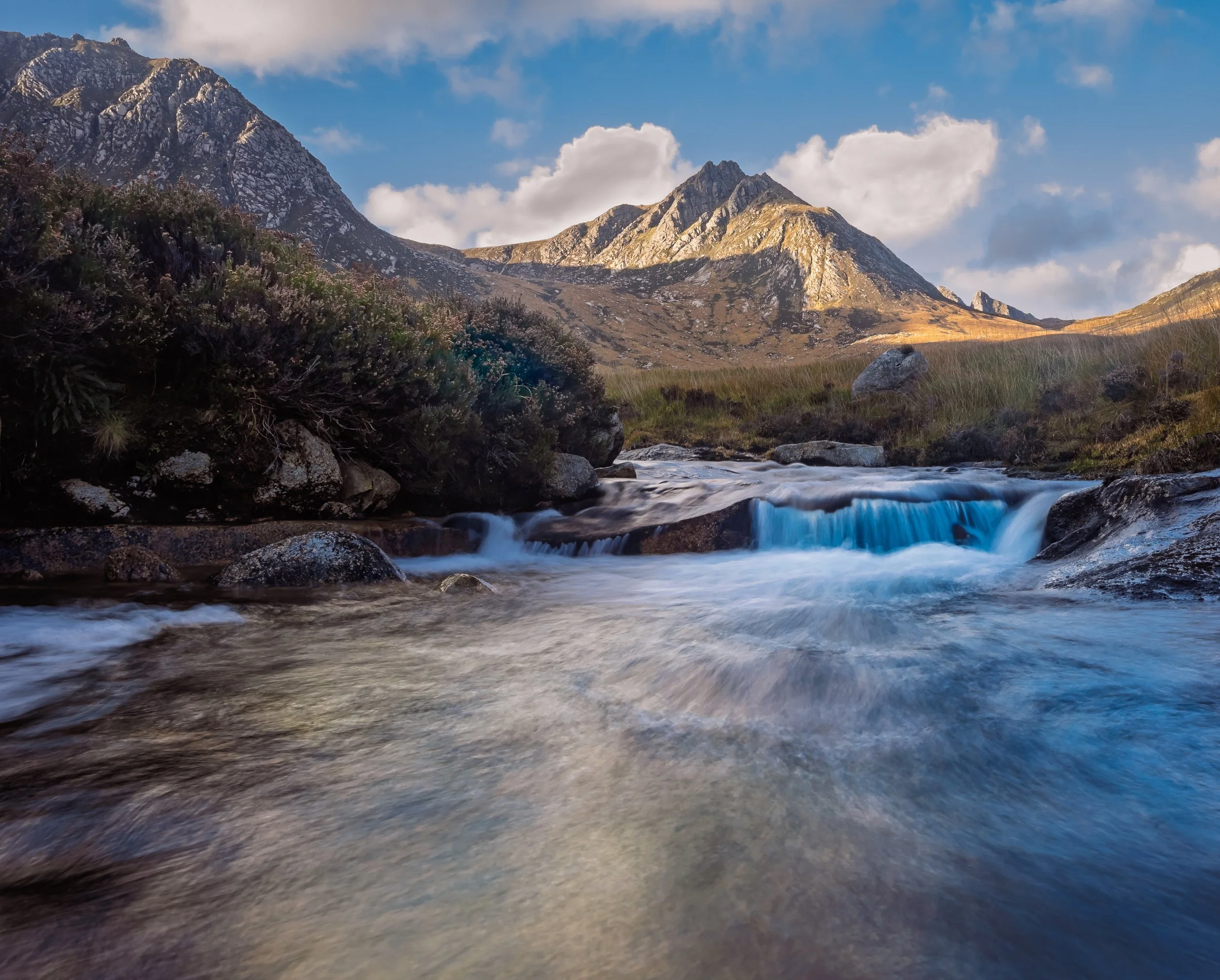
Cìr Mhòr across Glenrosa Water
(A Challenging Shoot in the Shadowy Depths of Glen Rosa;
I’ll let the viewer decide whether this image justifies the wader-full of granite-cold water which it comically incurred!) ;-0
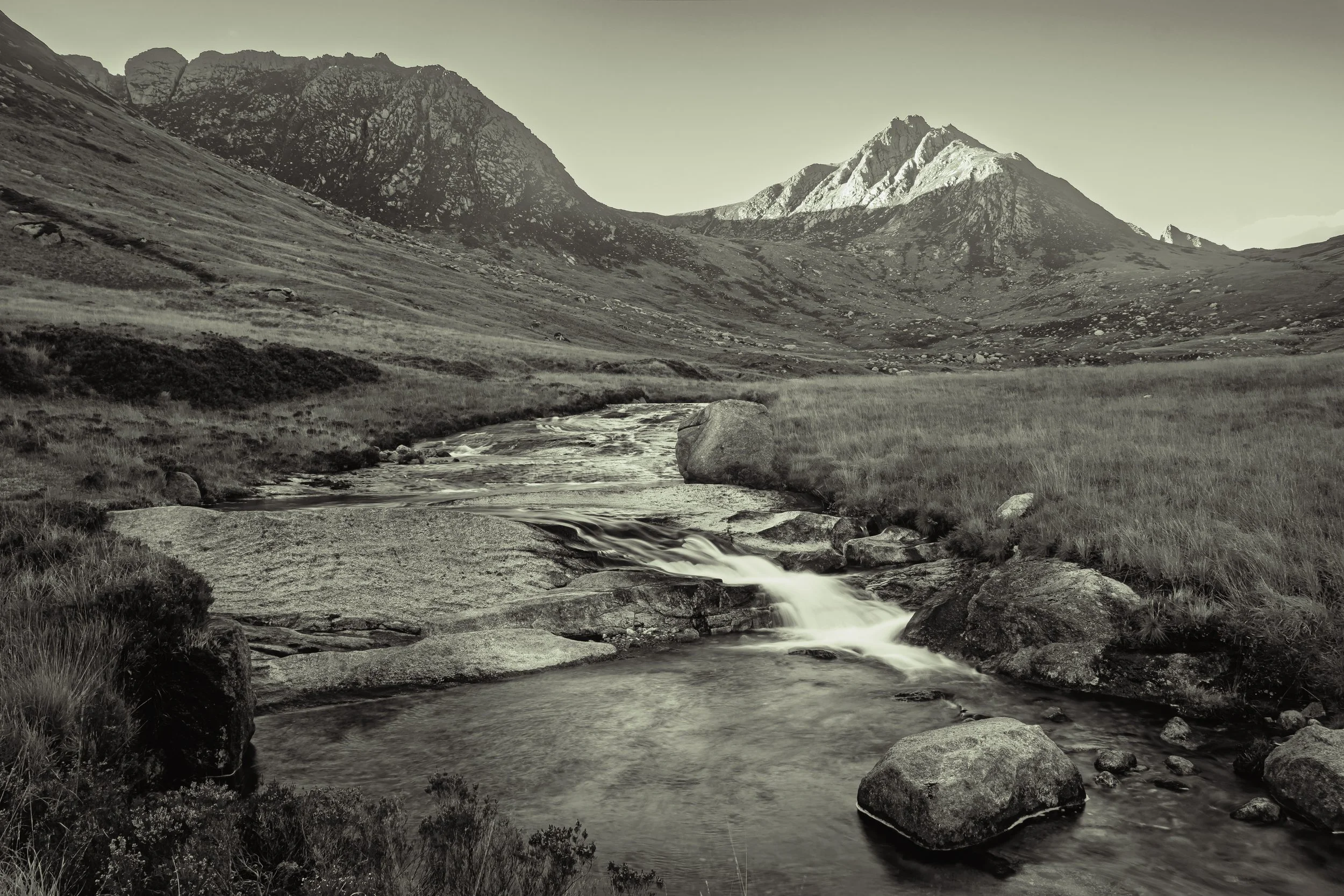
Last Light, Upper Glen Rosa
(Evening closes in on the Rocky Ramparts of A’Chir and Cìr Mhòr)
Russet and Rosa
(Glenrosa Water & Wood, October 2026)
As is invariably the case with phenomenal locations, my recent trip to Glen Rosa had only served to intensify, rather than satiate, my photographic itch. And sure enough, a few days later - just before the onset of this year’s turbulent autumn storms - I found myself walking in to the upper glen once more, my waders rustling slightly farcically with every welly-clad step!
This time, my primary aim was to explore a wee tree-lined gorge which runs largely unseen beneath the line of the path. As usual in Arran’s wilderness, this was easier said than done - for the unremittingly rough terrain, whether in the river itself or on its steep heathery banks, makes the going pretty tortuous as soon as the path is left behind. On top of this, most of my exploratory work turned out to be in vain, for I was greedily seeking foreground alignment with the towering granite hulk of Cìr Mhòr (which stands, sentinel-like and iconic, at the head of the glen).
It was only as I almost withdrew from the gorge completely that I compromised on a composition, my power-washed tripod precariously planted in the bed of the tumbling burn… :-)
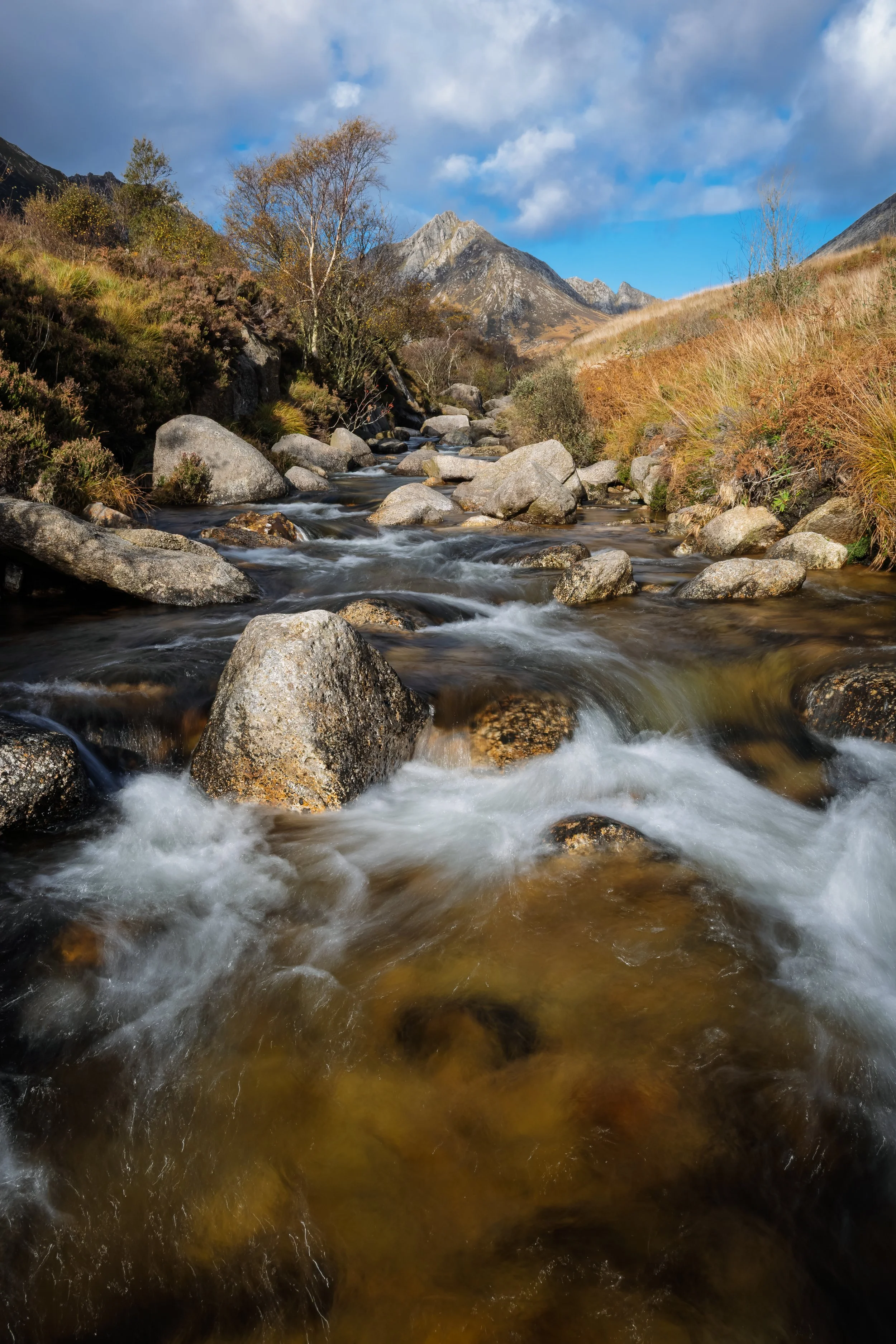
Rosa Gorge - My Opening Salvo
(Did my wide angle inadvertently highlight something ghoulish, lurking troll-like in the foreground?) :-0
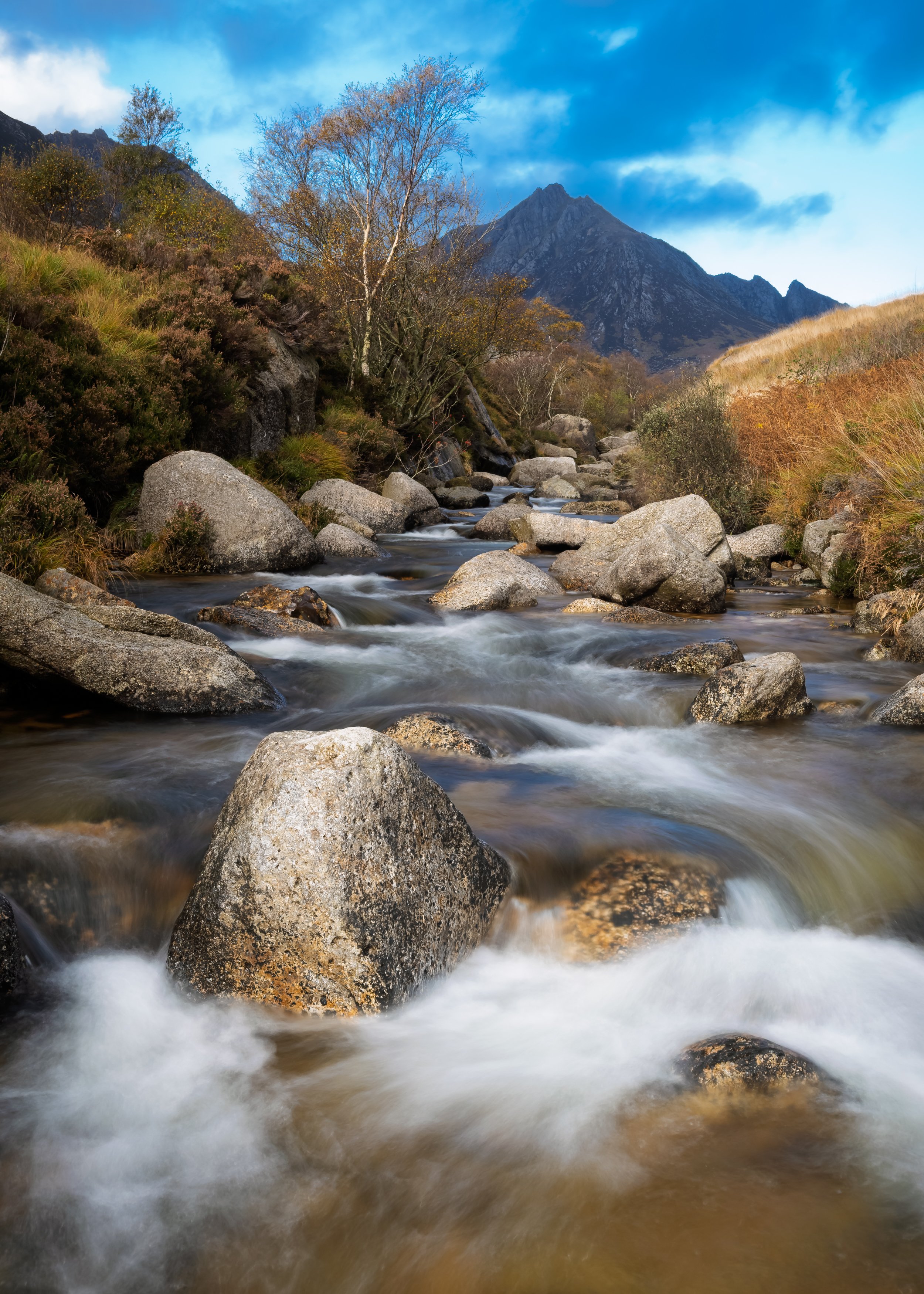
Russet and Rosa
(Autumn Falls, Glenrosa Water)
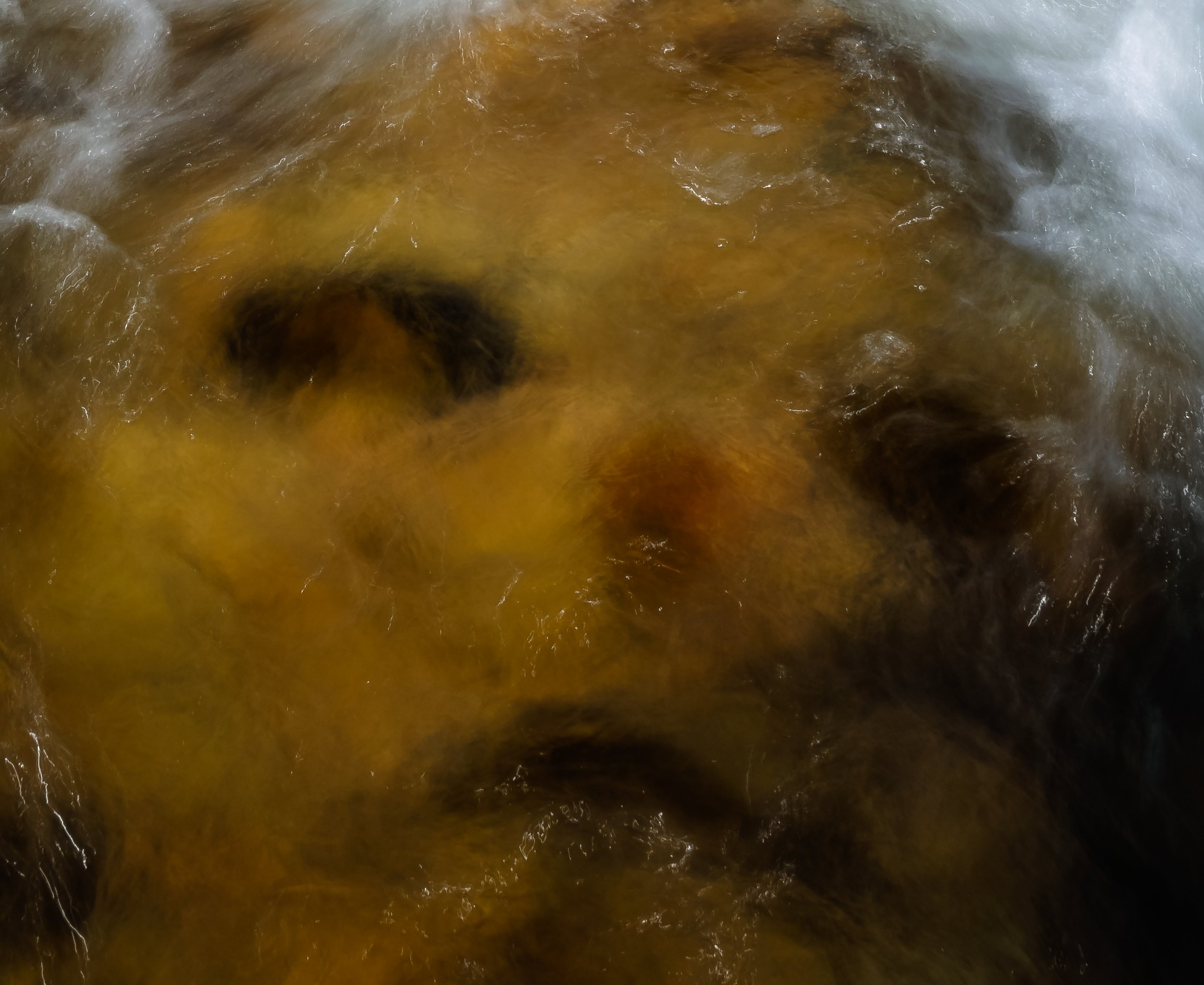
Alien Abstract, Glenrosa Water
(Focusing in on my spooky submerged friend, lurking beneath the peaty sunlit surface of the burn)
Any ideas for an appropriately aqueous name?
Pete (Peat) Waters, perhaps? Or Pete Burns? (I think the latter might already be taken!) ;-)
In this quest for a watery landscape, my ghoulish Alien Abstract was an unexpected bonus - reminding me, perhaps, that Halloween was not too far away! :-0
As a further bonus, the lower glen’s spread of emerging deciduous woodland really caught my eye as I rustled on home, prompting a final pair of ad-hoc pics (including a freaky attempt at a psychedelic abstract). This was a fitting end to the shoot, which I’d always intended to have something of an autumnal theme. In searching for scraps of russet back along the gorge, I evidently couldn’t see the trees for the forest! ;-)
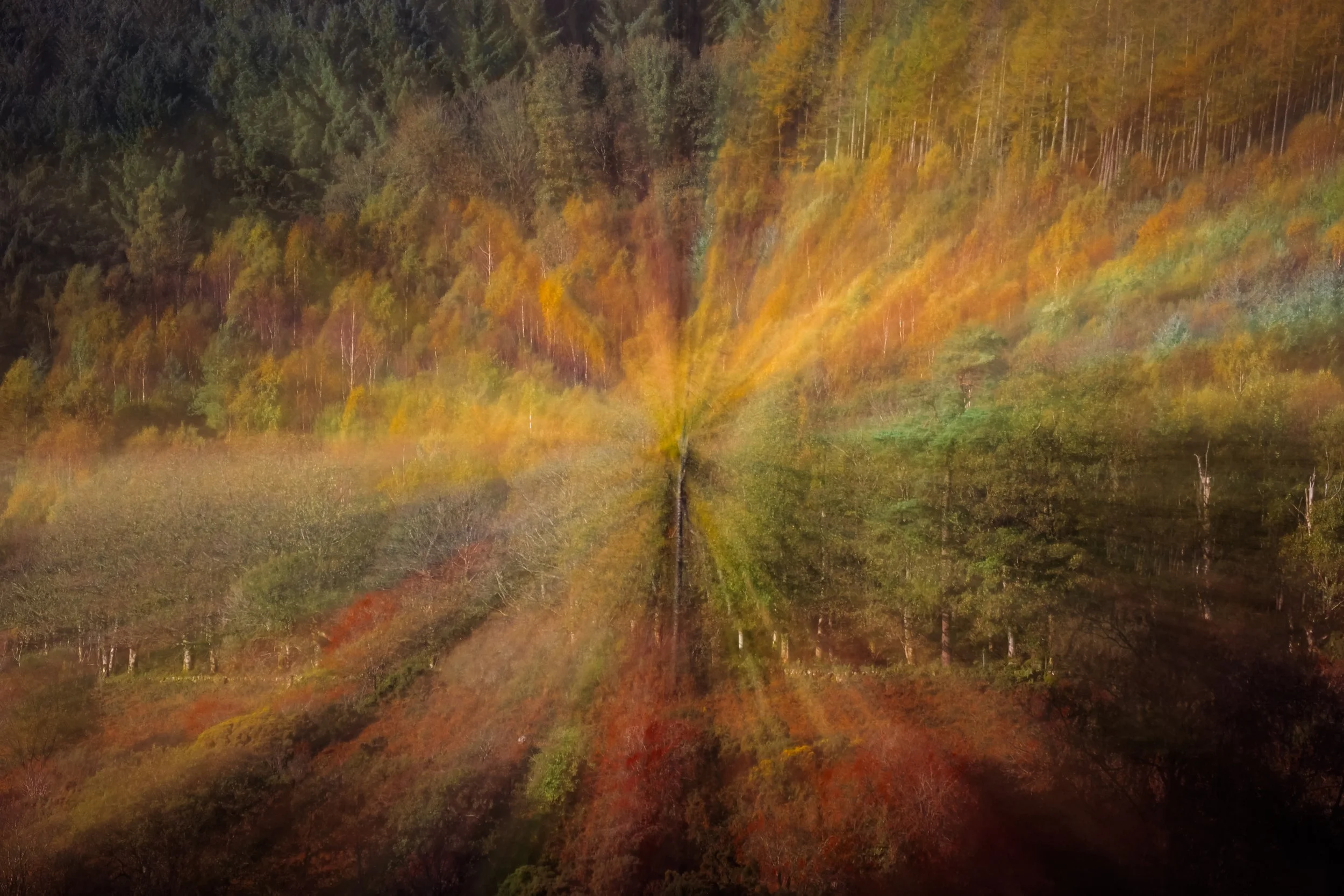
Autumn Burst, Lower Glen Rosa
(An ICM Zoom Abstract, where ICM = Intentional Camera Movement)
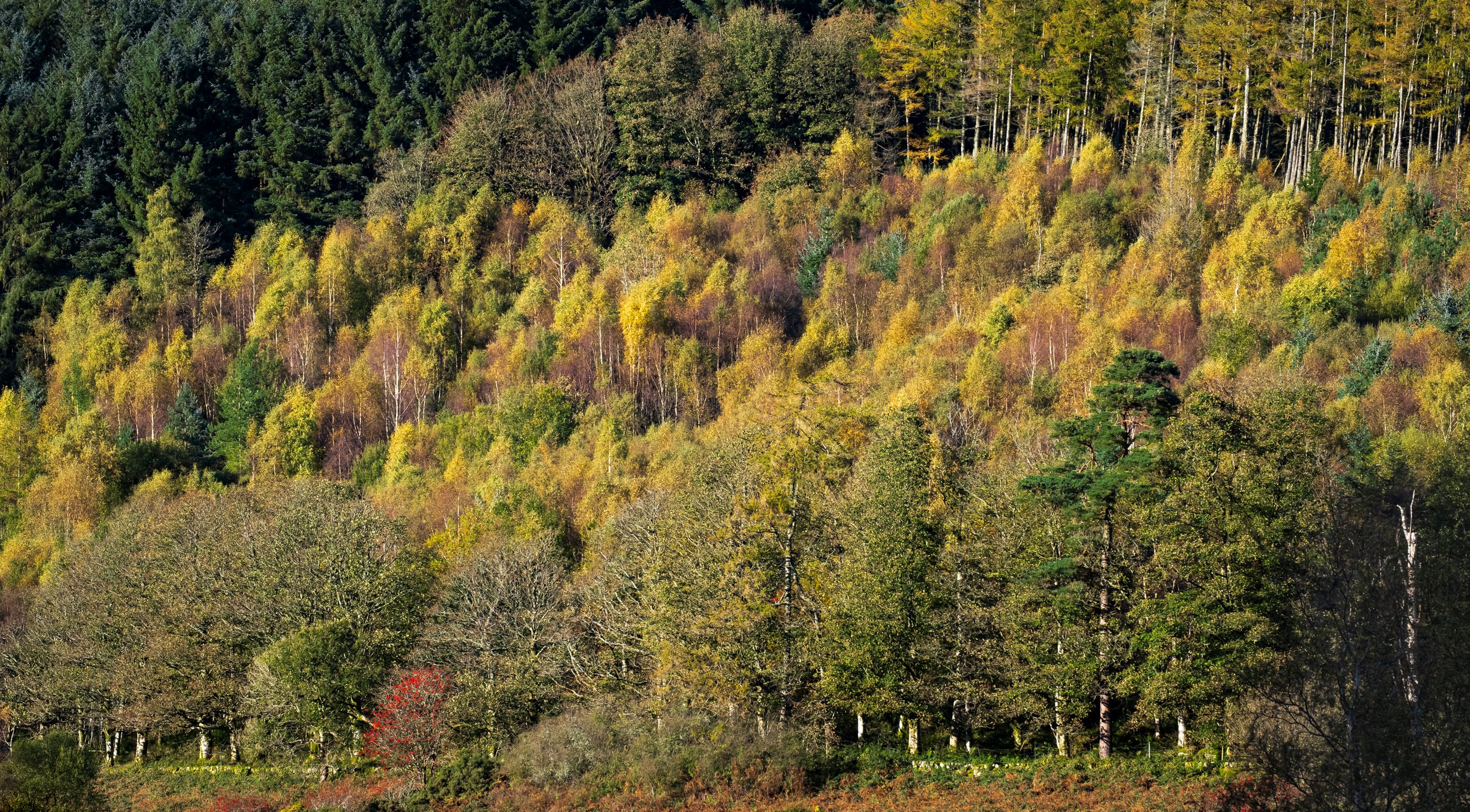
Forever Autumn
(Native Deciduous Woodland emerges from a Forest of Pine, Lower Glen Rosa)